

If you’ve ever searched for flights with four, five, or six passengers and watched the total price climb into the thousands, you know exactly what I’m talking about. That sinking feeling when you realize airfare alone might consume half your vacation budget has hit me more times than I care to count.
I’m walking you through the specific techniques and lesser-known strategies that actually work for reducing flight costs when you’re traveling with a large family, and how to fly cheaply with one.
Most articles on this topic regurgitate the same basic advice about booking early and being flexible, but I’m showing you the advanced tactics that most travelers never hear about.
These strategies can sometimes save you anywhere from several hundred to several thousand dollars on a single family trip, depending on your route and timing.
Check out your savings with our
✈️ Family Flight Savings Calculator
Discover how much you can save using advanced booking strategies for large families
Your Trip Details
Cost Comparison
💡 Recommended Strategies for Your Trip
Understanding Airline Fare Class Allocation Systems
Before we get into specific booking techniques, you need to understand how airlines actually price tickets when many passengers are involved. This foundation supports every money-saving strategy I’m about to share.
Airlines don’t have a single price for a route. They have many fare classes, typically ranging from Y (full-fare economy) down to Q, L, or even deeper alphabet letters representing progressively cheaper tickets.
Each fare class has limited seat inventory.
When you search for a single passenger, the system shows the cheapest available fare class. But when you search for five passengers, something different happens.
The airline’s reservation system reviews your request and attempts to allocate seats from the lowest available fare classes.
If the lowest fare class only has two seats remaining, the system assigns those two seats at that price, then moves to the next fare class for the remaining three passengers.
The result is that your whole group often gets bumped into a higher fare class, so everyone pays more than a solo traveler would, unless you book more strategically.
The basic rule of booking for large families is counterintuitive. Booking everyone together would be simpler and possibly cheaper through an imaginary group discount, but the opposite is actually true.
The reservation system treats multi-passenger searches as a single transaction requiring immediate seat allocation across potentially different fare classes.
What makes this even more frustrating is that the fare class system refreshes constantly based on booking patterns, competitor pricing, and demand forecasting algorithms. A fare class that had five seats available this morning might have only two seats by this afternoon.
Understanding this dynamic pricing structure is really the key to outsmarting the system.
The One-Passenger Search Strategy to Fly Cheaply with a Large Family
This is where theory meets practice, and where you’ll see the most immediate savings. Instead of entering your entire family into a single search, you’re going to search one passenger at a time and compare what you find.

Start by opening your preferred flight search engine and entering your route with just one passenger. Note the exact price, including all taxes and fees.
Now, without changing any other parameters, increase the passenger count to two and observe what happens.
In many cases, you’ll notice the per-person price increases slightly. Continue this pattern up to your full family size.
What you’re looking for is the breakpoint at which the per-person price jumps significantly. If searching for one passenger shows $250, two passengers show $255 each, three passengers show $260 each, and four passengers suddenly jump to $290 each, you’ve identified that the airline probably has three seats in the cheapest fare class and is bumping that fourth passenger into a higher class.
The solution is to book strategically instead of all at once. You might book three passengers at the lower rate immediately, then search again for the fourth passenger.
Sometimes that fourth ticket will still be $250 because the system allocates differently when handling a single-passenger request.
I’ve personally used this technique dozens of times, and the savings are consistently significant. On a family trip to Europe last year, searching for five passengers showed a cost of $680 per person.
Searching for one passenger showed $615.
I booked each family member separately and saved $325 total with about fifteen extra minutes of effort. The only downside is you’ll receive separate confirmation numbers, but that’s never caused me any actual problems at check-in or boarding.
The practical challenge here is that while you’re researching and deciding how to book, other travelers are doing the same, and inventory is disappearing. This is where speed matters.
Once you’ve identified the optimal booking strategy, execute it quickly.
Don’t spend hours deliberating, because fare classes can sell out while you’re thinking.
Mining Airline Hub Cities for Hidden Deals
Every major airline has hub cities where it operates significantly more flights and often offers more competitive fares to maintain market share. These aren’t secret, but most families don’t actually research which airlines dominate which cities, and they miss out on savings that can sometimes be very large.
Delta’s major hubs include Atlanta, Detroit, Minneapolis, and Salt Lake City. United dominates Chicago O’Hare, Denver, Houston, and Newark.
American Airlines focuses on Charlotte, Dallas-Fort Worth, Miami, and Philadelphia.
Southwest has significant operations in Baltimore, Chicago Midway, Denver, and Las Vegas. JetBlue’s focus cities include Boston and Fort Lauderdale, and it now concentrates most of its Southern California flying at LAX rather than Long Beach.
Why does this matter? Airlines price aggressively in their hub cities to fill planes and maintain market share.
If you live within a reasonable driving distance of a hub city, you can often access lower fares.
You can sometimes see differences like $450 versus $220 for the same route, simply by driving two hours to depart from a hub instead of your local airport.
The strategy here needs some initial research but pays ongoing dividends. Identify which major hubs are within a three to four-hour drive of your home.
Check whether any budget carriers, such as Spirit, Frontier, or Allegiant, operate from nearby secondary airports.
Then, for every trip you plan, compare prices from your local airport against these alternatives.
Last summer, my family was planning a trip to Orlando. Flying from our local regional airport would have cost $380 per person.
Driving ninety minutes to a Southwest hub city reduced the cost to $180 per person.
For our family of five on that trip, the $ 200-per-person savings totalled $1,000, more than covering gas, parking, and the slight inconvenience of the earlier departure from home.
The challenge with this approach is that it adds complexity to your travel day. You’re leaving earlier, managing longer drives with potentially cranky kids, and coordinating parking.
But the financial math is compelling, especially for families who take many trips per year.
That $1,000 saved on flights can pay for an extra night’s accommodation or cover theme park tickets.
Sophisticated Price Tracking Across Multiple Platforms
Most people know they should compare prices across different booking sites, but very few travelers actually understand how to set up a comprehensive tracking system that catches the deals that matter.
Airlines release fare sales at unpredictable times, often targeting specific routes or travel periods. These sales might last only hours before selling out.
Setting up proper price tracking means you’re notified immediately when prices drop, giving you a competitive advantage over travelers who check manually once per week.
Google Flights offers the most visually intuitive price tracking, showing you a calendar grid with prices for every day across two months. You can set up email alerts for specific routes, and the system will tell you when prices change significantly.
The interface also shows whether current prices are typical, high, or low compared to historical data for that route.
Skyscanner’s “Price Alert” feature works differently. It sends you notifications when prices drop by any amount, not just significant drops, which means you’ll receive more frequent emails but catch smaller opportunities.
Skyscanner often includes additional budget airlines that don’t always appear in other search tools, including Spirit, Frontier, and various international discount airlines.
Hopper is a mobile app that uses predictive algorithms to recommend whether you should book now or wait. It analyses billions of flight prices and claims to forecast with reasonable accuracy whether prices will rise or fall.
In my experience, its predictions are accurate around 70% of the time, which is better than guessing, but not reliable enough to base major decisions on by itself.
Scott’s Cheap Flights, now called “Going,” operates differently from automated tools. Real humans find mistake fares, pricing errors, and limited-time deals, then send email alerts to subscribers.
The free version covers domestic deals and limited international routes.
The premium version, typically priced in the tens of dollars per year, includes international business-class deals and more comprehensive coverage, though exact pricing can vary.
Here’s my actual system. I set up Google Flights price tracking for my target routes about six months before planned travel.
I also subscribe to Scott’s Cheap Flights Premium and to the email newsletters of every airline that serves my local airports.
This creates many monitoring streams that catch different types of deals.
The challenge here is alert fatigue. You’ll receive many emails, most of which won’t be relevant.
The solution is to use email filters and folders to automatically sort flight alerts out of your main inbox, so you can review them on your schedule instead of being constantly interrupted.
Want broader tips beyond family travel? Read how to find cheap flights in 2026 with 10 pro travel hacks.
Alternative Airport Arbitrage
Major metropolitan areas typically have many airport options, and the price differences between them can be staggering. This technique involves understanding the competitive dynamics between airports serving the same region.
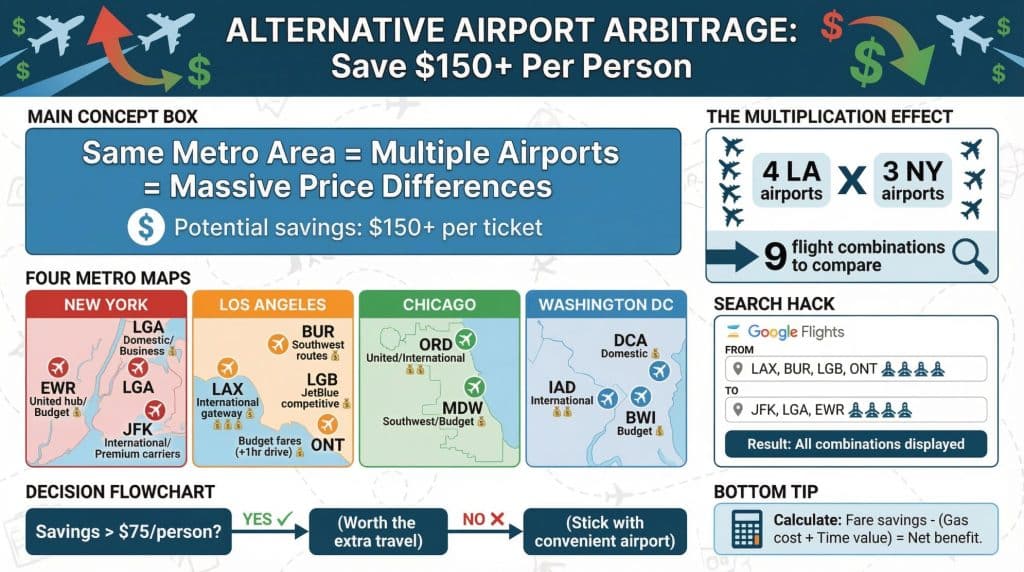
New York has three major airports serving different airline strategies. JFK handles significant international traffic and premium carriers.
LaGuardia focuses on domestic routes and business travelers.
Newark has become United’s main hub in the New York area and also serves some lower-cost carriers on certain routes. For the exact same destination on the same dates, I’ve seen price differences exceeding $150 per person depending on which New York airport I choose.
Los Angeles has similar dynamics. LAX is the massive international gateway with premium pricing.
Burbank is smaller and often cheaper, especially on Southwest.
Long Beach is a smaller, easier-to-navigate airport that now hosts a mix of mainly domestic routes, after JetBlue shifted most of its flying to LAX. Ontario, about an hour east, can sometimes have significantly lower fares on both legacy and budget carriers, depending on the route and dates.
Chicago has O’Hare for United and many international routes, while Midway is dominated by Southwest and other lower-cost options that can often be cheaper on some domestic routes.
Washington DC has Dulles, Reagan National, and Baltimore, technically serving the same metro area, each with distinct pricing patterns.
The strategy is to search all viable airports within your metro area as both departure and arrival points. That means if you’re traveling from Los Angeles to New York, you’re not comparing two flight options, you’re comparing nine: LAX to JFK, LAX to LGA, LAX to EWR, BUR to JFK, BUR to LGA, BUR to EWR, LGB to JFK, LGB to LGA, and LGB to EWR.
This sounds tedious, and honestly, it is, but the savings justify the effort. Google Flights makes this easier by allowing you to enter many airport codes.
Instead of “LAX,” enter “LAX, BUR, LGB, ONT” as your departure, and “JFK, LGA, EWR” as your arrival.
The system searches all combinations and shows you the cheapest options.
The practical challenge is transportation logistics. If you live in West LA, flying from Ontario means an extra hour of driving.
You need to calculate whether the time and gas cost justify the fare savings.
Generally, savings of $75 or more per person make choosing airports worthwhile for my family.
Strategic Calendar Manipulation for Maximum Savings
Most families search flights by entering specific dates: “We’re traveling June 20-27.” This rigid approach costs you money. Airlines price dynamically based on demand patterns, and shifting your dates by even one or two days can create substantial savings.
Google Flights has a calendar view that shows prices for every day over two months. Instead of searching for specific dates, enter your approximate timeframe to view the entire calendar.
You’ll immediately see which days are significantly cheaper.
Traveling June 19-26 instead of June 20-27 saves $80 per person. For a family of five, that’s $400.
The pattern you’re looking for is valleys between demand peaks. School holidays create obvious demand spikes, but there are subtle patterns too.
The weekend immediately before a major holiday is expensive, but the weekend two weeks before is often cheap.
Similarly, returning on Tuesday instead of Sunday often saves substantial money because you avoid the rush of returnees returning for Monday morning work.
Shoulder seasons represent the most dramatic savings opportunity. These are the two-week periods immediately before and after peak travel seasons.
For European travel, late May and early September are shoulder seasons that offer 30-40% savings compared to June through August, while the weather is still generally excellent.
For Caribbean destinations, late April and early November work similarly.
I’ve built enough flexibility into my family schedule that we can often shift trips by a few days based on pricing. When planning our annual beach vacation, I search for a two-week window and identify the cheapest three-day period within it.
Typically, this saves us $500-800 compared to randomly picking dates without price comparison.
The challenge is coordinating this flexibility with work schedules, school calendars, and other commitments. Not every family can shift vacation dates arbitrarily.
But even small amounts of flexibility help.
If you can adjust by two days in either direction, you’ve given yourself a five-day window instead of fixed dates, and that’s often enough to find significantly better pricing.
Budget Carrier Fee Structure Navigation
Budget airlines advertise incredibly low base fares, sometimes as little as $39, but the final price, including all fees, can exceed that of legacy carriers on the same route. Understanding the fare structure is essential to determining whether budget carriers actually save large families money.
Spirit Airlines charges for carry-on bags. Yes, you read that correctly, not just checked bags but carry-ons.
The fee ranges from $40 to $65 per bag, depending on whether you pay during booking, online check-in, or at the gate.
For a family of five, each bringing one carry-on, that’s potentially $200-325 in bag fees alone.
Frontier operates similarly, charging for carry-ons and seat selection. If you don’t pay for seat selection, the system randomly assigns seats, often splitting families across the aircraft.
Paying for seat selection to keep your family together adds $10-$30 per person per flight segment.
Allegiant charges for virtually everything: bags, seats, priority boarding, and even printing boarding passes at the airport. The base fare might be $59, but after fees, the actual cost approaches $150 per person.
The calculation you need to make is a total cost comparison. Take Spirit’s $79 base fare, add carry-on fees ($50), add checked bag fees if needed ($40), add seat selection to keep the family together ($25), and the total comes to $194. That’s the real cost.
Now compare that with United’s $220 fare, which includes carry-on, one personal item, and a free seat assignment.
The legacy carrier is cheaper when you account for the final cost.
Where budget carriers do provide genuine value is when you can travel ultra-light with only personal items, which stay free, and you don’t care about sitting together. For quick weekend trips or older kids who don’t need adjacent seating, budget carriers can still deliver substantial savings.
I typically use budget carriers for short flights under two hours, where service quality matters less, and I avoid them for longer flights or when traveling with young children who need to sit with adults
This selective approach captures genuine savings opportunities while avoiding scenarios in which budget carriers become more expensive and significantly less convenient.
Try our Widget out to calculate the best fare
✈️ Budget vs Legacy Airline Calculator
Compare the true cost of budget and legacy carriers including all fees and add-ons. See beyond the base fare to make informed travel decisions.
| Cost Item | Budget Airline | Legacy Carrier |
|---|---|---|
| Base Fare | $59.00 | $189.00 |
| Carry-On Bag | Included | FREE |
| Checked Bags | $0.00 | $0.00 |
| Seat Selection | Random (FREE) | INCLUDED |
| Priority Boarding | $0.00 | N/A |
| Flight Flex | $0.00 | N/A |
| WiFi | Not Purchased | VARIES |
| Drinks & Snacks | Not Purchased | FREE |
| TOTAL PER PERSON | $59.00 | $189.00 |
| TOTAL FOR 1 PASSENGER(S) | $59.00 | $189.00 |
Frequently Asked Questions
How far in advance should I book flights for a large family?
For domestic flights, the sweet spot is typically 6-8 weeks before departure. For international travel, aim for 3-4 months in advance.
However, these are general guidelines.
Setting up price alerts starting six months out lets you watch pricing trends and book when you spot a genuine deal, rather than following arbitrary timing rules.
Can I book separate tickets for family members and still sit together?
Yes, you can. After booking separate reservations, call the airline directly and explain that you have many bookings under different confirmation numbers but want seats together.
Most airlines will accommodate this request, especially when children are involved. Alternatively, many airlines now allow you to manage seats through their app or website by linking reservations.
Do airlines offer family group discounts?
Contrary to what many people believe, most airlines do not offer automatic family discounts. Group rates typically apply to 10 or more passengers traveling together, and even then, group fares are often higher than booking individually during sales.
Your best savings come from the strategies I've outlined, not from requesting group rates.
Is Southwest really cheaper for families?
Southwest can be significantly cheaper for families, specifically because of their two free checked bags policy and no change fees. When you calculate the total cost, including baggage, for a family of five, Southwest often beats competitors even when their base fare appears slightly higher.
However, always run the full calculation because this isn't universally true on every route.
Should I use travel agents for booking large family trips?
Travel agents can add value when booking complex international itineraries or package deals, but for domestic flights, you'll typically find better deals by booking directly. The exception is specialized family travel agents who have access to consolidator fares or package deals that aren't available to the public.
For straightforward domestic flights, the DIY approach using the strategies I've outlined almost always yields better results.
What day of the week are flights cheapest?
Tuesday and Wednesday flights are often cheaper because business travelers prefer Monday/Friday and leisure travelers prefer weekends. However, this pattern is weakening as airlines become more sophisticated with dynamic pricing.
Instead of following day-of-week rules, use the calendar view on Google Flights to actually see price variations across the entire month.
Are mistake fares real and can I actually book them?
Yes, mistake fares are real. They happen when airlines or booking systems accidentally publish dramatically reduced prices due to currency conversion errors, manual input errors, or technical glitches.
When you find one, book immediately and avoid calling attention to it.
Airlines usually honor mistake fares for tickets already issued, though they technically can cancel them. I've successfully booked three mistake fares over the years, saving thousands.
How do I find which airports are hubs for which airlines?
The simplest method is to check each airline's route map on its website, which clearly shows its hub cities and the most connections. Alternatively, Wikipedia has comprehensive lists of airline hubs.
Once you know the hubs within driving distance, bookmark them and always compare prices from those airports against your local one.
What we Learned
Search for one passenger at a time to identify fare class breaks, rather than booking all family members simultaneously, which can sometimes save $30–100+ per person by avoiding being pushed into higher fare classes.
Research airline hub cities within driving distance and compare prices from many airports in your region, as hub pricing advantages and alternative airports can sometimes generate $200–500 per person savings on similar routes.
Implement comprehensive price tracking across Google Flights, Skyscanner, and deal alert services like Scott's Cheap Flights to catch fare sales and mistake prices that sometimes disappear within hours, saving 30–50% on some flights.
Build calendar flexibility into your travel planning by searching for two-week windows instead of fixed dates, capturing shoulder-season pricing, and avoiding peak-demand periods that artificially inflate costs.
Calculate total costs, including all fees, when comparing budget carriers against legacy airlines, as carry-on charges, seat selection fees, and baggage costs often make advertised low-cost carriers more expensive than traditional airlines for family travel.
Affiliate Disclosure for Smart Miles Traveler
At Smart Miles Traveler (https://smartmilestraveler.com), our goal is to provide helpful, honest, and practical travel tips, product recommendations, and money-saving strategies.
Some of the links on this website are affiliate links. This means that if you click on a link and make a purchase, we may earn a small commission at no extra cost to you.
These commissions help support the operation of this website and allow us to continue creating free, high-quality travel content for our readers.
Questions or Concerns
If you have any questions about our affiliate relationships or how this website operates, please feel free to contact us.
📧 Email: info@smartmilestraveler.com