

Booking.com connecting rooms can be surprisingly hard to secure, but there’s a way to stack the odds in your favor.
Booking connecting rooms used to stress me out. You select a hotel, enter your info, and hope the “special request” box works, it usually doesn’t.
But after some trial and error and a few awkward family situations, a pattern emerges. You don’t need secret contacts or elite status, you just need to work with how Booking.com and hotels actually assign rooms. It isn’t magic or a loophole. Just a strategic way to stack the odds in your favor.
The Real Problem With Booking Connecting Rooms Online
Most families trying to book Booking.com connecting rooms quickly discover you can only request them, not truly reserve them.
Here’s the core issue with connecting rooms. Most booking platforms, including Booking.com, only let you request them, not reserve them.
You can hope for them.
Typing in all caps in the special requests box rarely helps.
But the hotel doesn’t guarantee anything.
The rooms exist, especially in newer, family‑oriented hotels. But the booking systems are built around selling you “2 queen beds” or “1 king bed” as separate items. The connecting door itself is treated as a behind‑the‑scenes detail, not a selectable feature.
Most families just accept this and hope for the best. Or they call and book the hotel directly, which often works but takes time and can mean missing out on Booking.com deals, promos, and loyalty perks. There is a better way that combines both.
You keep the online savings and convenience, while still making your request almost impossible to ignore.
How Booking.com Actually Handles Room Requests
Before getting into the strategy, it helps to understand what’s happening behind the scenes at a very simple level.
When you book through Booking.com:
- Your reservation is entered directly into the hotel’s system or channel manager.
- Any special requests you type go into a notes field attached to that reservation.
- Front desk or reservations staff see those notes when they’re assigning rooms.
- Those notes are suggestions, not binding promises.
The special request box isn’t useless, but it’s not a guarantee.
The hotel can ignore it if needed, especially when things get busy or inventory is tight. Most don’t want to disappoint families, because reviews matter, but you can’t rely on goodwill alone.
The real key is timing and repetition. Making sure your request is visible, clear, and reinforced at the moments when room assignments are actually being made.
Connecting vs Adjoining: What You’re Really Asking For
A quick definition check helps avoid misunderstandings at the desk.
- Connecting rooms: Two rooms with an internal door between them.
- Adjoining/adjacent rooms: Next to each other or very close, but no interior door.
Many properties only have a limited number of true connecting pairs. Some older hotels might have only a few sets across the entire building. Newer or family‑focused hotels often have more, but they’re still far from unlimited.
The goal isn’t to demand connecting rooms, it’s to make it easy for the hotel to give your family one of those limited pairs.
Booking.com Connecting Rooms: The Step‑By‑Step Strategy That Works
Think of this as a simple playbook. Each step helps your request rise to the top of the pile.
Step 1: Book Early (Like, Really Early)
Sometimes trips come together at the last minute, and there’s no choice. But if you have any control at all, booking early helps more than almost anything else.
Hotels usually assign specific rooms closer to arrival. When you book a few months in advance:
- Your reservation is in the system long before most others for those dates.
- When staff start assigning rooms, your connecting‑room request has first crack at the available pairs.
- Off‑peak dates, plus early booking, nearly always offer the best flexibility.
Booking early doesn’t guarantee anything, but it moves you from last‑minute afterthought to a family that can plan around.
You can start a search and see what’s available for your dates directly on Booking.com.
Step 2: Use the Special Requests Box Strategically
Don’t just type “connecting rooms, please” and call it a day.
Be specific, be polite, and give context. For example:
“Traveling with young children, requesting connecting rooms if available. Room numbers XXX and XXX, if possible, or any connecting rooms on the same floor. Will call to confirm 3 days before arrival.”
This style of message does four important things:
- Shows you’re serious (you mention a follow‑up call).
- Gives flexibility (connect if possible; otherwise, same floor).
- Provides context (kids = safety and sleep issue, not a random preference).
- Signals you understand hotel operations (room numbers, floor, timing).
You sound organised and reasonable, making it much easier for staff to help.
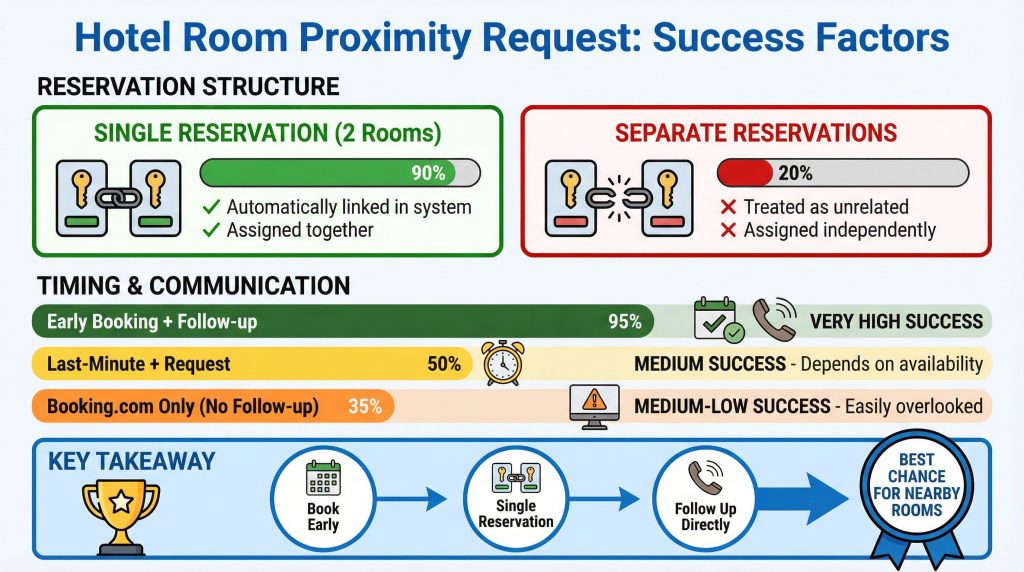
Step 3: Book Both Rooms in One Reservation
This part is huge.
When searching on Booking.com, increase the room count to 2 or more under the same reservation. Don’t create separate bookings for each room.
Why this matters:
- A single confirmation number containing multiple rooms is a strong signal that the rooms belong together.
- Two separate confirmations can be treated as completely unrelated bookings, potentially assigned on different days by different staff.
- Linked rooms in one reservation are much easier to pre‑block together.
Booking Approach Comparison
Different ways of chasing Booking.com connecting rooms have very different success rates.
Step 4: Call the Hotel 3–5 Days Before Arrival
This is the real “hack” part of the whole family travel hack equation.
After you book through Booking.com (and lock in your chosen rate, points, or promotions), call the actual hotel front desk, not Booking.com support.
Have your confirmation number ready and say something like:
“I booked two rooms through Booking.com and requested connecting rooms in the special requests. I wanted to follow up and check if that’s possible.”
Typical responses you might hear:
- “Let me make a note of that for you.”
- “I’ll do my best; I’ve flagged your reservation.”
- “We can’t guarantee it yet, but I’ve added it to your booking.”
Each of these is better than silence. At this point, they can:
- See your full reservation details.
- Add extra internal notes or flags.
- Sometimes, assign specific room numbers ahead of time.
Most hotels pre‑assign rooms 24 to 48 hours before check‑in. A call 3–5 days ahead puts your request fresh in their mind right as they’re starting that process.
Step 5: Follow Up Again at Check‑In
Finally, check‑in is your last chance to nudge things in your favour.
Before they hand over the keys, say something along the lines of:
“I called earlier this week about connecting rooms. Were you able to accommodate that?”
If they’ve forgotten, or if the system placed you apart, this is the moment where staff can sometimes reshuffle things, especially if you:
- Stay calm and friendly.
- Show that this really matters for your family (kids, elderly relatives, safety, etc.).
- Are open to small compromises (different floor, slightly different view category, etc.).
Hotels often hold back a few rooms for operational issues. If connecting rooms are still available, a polite reminder can make the difference.
Why This Beats Other Methods
A lot of approaches seem promising, but don’t actually move the needle much on connecting rooms:
- Booking directly through hotel websites: Sometimes more expensive and still often “subject to availability” for connecting doors.
- Relying only on loyalty programs: Status can help, but usually doesn’t create a hard guarantee.
- Showing up and hoping: Very low success rate, especially in busy periods.
- Paying for suites instead: More space, but often much more expensive than two standard rooms.
The Booking.com + phone call combo works because you’re stacking multiple advantages:
- Online deals and convenience.
- One clear combined reservation.
- A written request in the notes.
- A timely phone call that adds weight to that request.
- A polite in‑person reminder at check‑in.
You’re not gaming the system, you’re using it in the order that actually matters.
The Genius Level Factor
If you’re part of Booking.com’s Genius loyalty program, you can get perks like discounted rates, free breakfasts, or room upgrades at some properties. At higher Genius levels, you’ll sometimes see better room types or extra benefits for the same price.
This doesn’t flip a switch for guaranteed connecting rooms, but it can help in subtle ways:
- Hotels may prioritise repeat or higher‑value guests when multiple families have similar requests.
- Genius discounts can make larger rooms, family suites, or better‑located options more affordable.
Signing up is free, and perks unlock after a few completed stays. It’s a small, easy edge that blends nicely with the strategy above.
For a wider look at whether guidebooks still deserve a place in your planning, check out my in‑depth Lonely Planet review.
When This Strategy Won’t Save You
No strategy is perfect. There are situations where even a careful approach may still fail:
- Fully booked hotels: When the property is at 100% capacity for a big event or holiday, staff have almost no flexibility. If every connecting pair is already taken, they can’t move people out just for you.
- Older hotels with very few connecting rooms: Some buildings were not designed for many internal doors. If they only have a handful of pairs and those are already sold, that’s it.
- Very late bookings: If you book the day before arrival, specific rooms may already be assigned. Staff might try to reshuffle, but it’s much harder.
- No follow‑up: Relying only on the special requests box tends to produce hit‑and‑miss results. The call a few days before arrival is often what pushes your request into the “we should really try” category.
Knowing these limits helps you adjust your expectations and decide when a guaranteed chain option or another property might make more sense.
Backup Plans If Connecting Rooms Don’t Work Out
Even if you do everything “right,” sometimes connecting rooms just aren’t available for your dates. In that case, you still have options that keep the trip manageable:
- Adjoining rooms: No internal door, but right next to each other. Ask for this as your second choice.
- Same floor, close together: Still workable, especially if kids are older. Much better than being split across floors or wings.
- Suites with separate sleeping areas: One larger unit instead of two rooms—often a bedroom plus living area with a sofa bed or bunks.
- Ground‑floor rooms near each other: Helpful if you’ve got strollers, lots of luggage, or mobility concerns.
The connecting door is ideal, but these setups can still keep your family close enough to stay sane.
Other Family Travel Hacks When Using Booking.com
While you’re already optimising your Booking.com flow, a few extra habits can make family travel easier overall:
- Filter by family‑friendly amenities: Use filters for cribs, family rooms, pools, kitchenettes, breakfast, and more. This keeps you from wasting time on hotels that aren’t kid-friendly.
- Read reviews from other families: Look for comments mentioning noise, breakfast, pool quality, and room layouts. Parents tend to be very specific about what worked and what didn’t.
- Book refundable rates when it makes sense: Paying a bit more for free cancellation can be worth it when schedules, health, or school events are unpredictable. You can always switch to a cheaper, non‑refundable option closer to the date if your plans are solid and the price improves.
- Use the map view: Make sure the hotel is actually near what you care about—parks, attractions, transit, family‑friendly restaurants. With kids, a bad location can be more exhausting than a small room.
If you want to upgrade your packing game, too, read
“How to Pack Light for Family Travel Without Sacrificing Essentials” next.
The Bottom Line: A Simple, Repeatable System
This system turns booking Booking.com connecting rooms from a coin flip into a repeatable process you can reuse on every family trip. Booking connecting rooms through Booking.com isn’t actually complicated once you understand how hotels treat requests. The basic system looks like this:
- Book early whenever you can.
- Keep both rooms in a single Booking.com reservation.
- Write a clear, context‑rich special request.
- Call the hotel 3–5 days before arrival.
- Mention the request again—politely—at check‑in.
That’s it.
There’s no hidden trick or secret “code word.” You’re simply using the tool correctly and speaking the hotel’s language.
Most families skip the call because it feels old‑fashioned or time‑consuming. But those few minutes on the phone can prevent a lot of stress, late‑night room swaps, and hallway marathons between floors.
Getting connecting rooms isn’t about being high‑maintenance; it’s about making family travel actually manageable. Next time you’re planning a trip, try this sequence: book both rooms together on Booking.com, write a strong request, follow up with the hotel a few days before, and ask again at check‑in.
You might be surprised by how often it works and how much calmer your next family trip feels when everyone’s finally on the same side of the hallway wall.
Affiliate Disclosure for Smart Miles Traveler
At Smart Miles Traveler (https://smartmilestraveler.com), our goal is to provide helpful, honest, and practical travel tips, product recommendations, and money-saving strategies.
Some of the links on this website are affiliate links. This means that if you click on a link and make a purchase, we may earn a small commission at no extra cost to you.
These commissions help support the operation of this website and allow us to continue creating free, high-quality travel content for our readers.
Questions or Concerns
If you have any questions about our affiliate relationships or how this website operates, please feel free to contact us.
📧 Email: info@smartmilestraveler.com