

🧳 Kid Travel Difficulty Calculator
Discover how challenging travel will be based on your child’s age, plus get personalized tips and gear recommendations
Main Challenges
What to Expect
💡 Travel Tips for This Age
🎒 Recommended Gear
Remember: Every child develops differently. These guidelines are based on typical development patterns, but your child may be easier or harder to travel with than average. Trust your parental instincts!
When considering family travel, many parents wonder, “What Age Is Hardest to Travel With Kids?” This is particularly true for those with children in the 9 to 18 month age range.
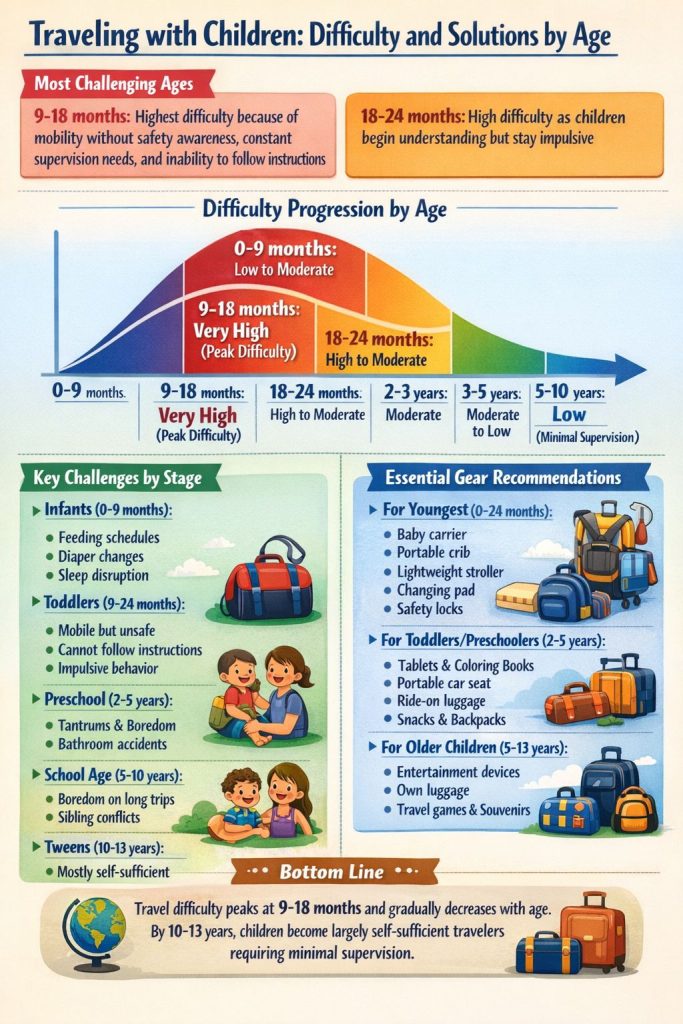
The 9 to 18 month age range is by far the most difficult period for traveling with kids.
This is when your baby gets mobile (around 9 months) but can’t follow directions or sense danger. They constantly want to move, resist being held, and their sleep is disrupted by every environmental change.
Parents call this window a perfect storm for travel. Your child is too big and squirmy for your lap, too young to reason with, and too curious to sit quietly at dinner.
The good news is this phase doesn’t last forever. Things start improving around 18 months for some kids, and by age 3 or 4, travel gets genuinely easier.
Understanding the Question
When parents search for the age when traveling with kids is hardest, they’re usually trying to decide whether to book that family vacation or wait another year.
The answer actually matters quite a bit for planning purposes. Nobody wants to drop thousands of dollars on a trip only to spend the entire time chasing a toddler through airport terminals or dealing with meltdowns in the hotel room.
To understand travel challenges at each age, let’s break down what makes particular phases more difficult than others.
Very young babies (newborn to about 6 months) are surprisingly portable. They sleep a ton, eat on demand, and aren’t mobile yet.
You can basically wear them in a carrier and go about your day.
Older kids (around 3 and up) can follow basic instructions. They understand “stay in your seat” and “hold my hand.” They can also entertain themselves with tablets or books for reasonable periods.
The brutal middle phase is where everything falls apart. That’s the toddler window where your kid has gained independence but has zero impulse control or self-preservation instincts.
The 9-18 Month Window: Why It’s Genuinely Awful
The period from 9 to 18 months is a travel disaster scenario.
Your child is no longer content to sit in your lap. They want to crawl or walk constantly.
At the same time, they have no concept of danger and can’t understand why they can’t just wander off.
The Mobility Problem
Once babies start crawling around 9 months, the game changes completely.
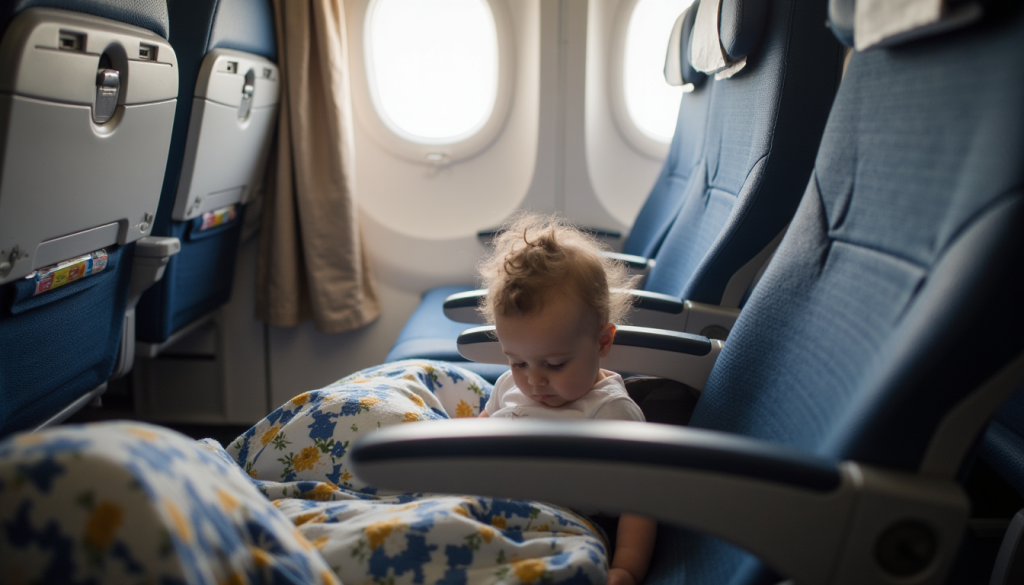
On a flight, you’re dealing with a child who fights being held, resists sitting still, and grows upset as you try to contain them. For parents, it is like wrestling a strong, angry octopus for hours.
You can’t just explain “we need to stay seated during takeoff.” They don’t get it. Distraction only works for so long.
Eventually, you’re just… suffering through it.
Sleep Gets Wrecked
Where younger babies might sleep almost anywhere, toddlers in this age range are super aware of their environment.
They know they’re not home and feel stressed by new surroundings.
They won’t settle easily, so you get an overtired, cranky kid… which makes them harder to manage.
One travel blogger described trying to get her 10 month old to sleep in a hotel room as “the longest three hours of my life.” The kid knew something was different and fought sleep the entire time.
Every Environment Becomes a Trap
9 to 18 months, your child moves fast but lacks self-preservation.
Hotel stairs. Random outlets.
Decorative items they can pull down.
Pools. Anything on a table.
Everything is a hazard that requires constant vigilance.
This means you can’t actually relax on your “vacation” because you’re in full-on safety mode the entire time. It’s exhausting.
You Can’t Reason With Them
Traditional discipline doesn’t work at this age because toddlers literally lack the cognitive development to understand consequences.
You can’t explain why they shouldn’t climb or bribe them with “if you behave now, we’ll go to the park later.” They don’t understand time or delayed rewards.
Your only tools are distraction and physical redirection, which get old really fast when you’re trying to enjoy a meal or navigate a crowded airport.
When Things Start Getting Better (18-24 Months)
Around 18 months, you might start seeing some improvement. Keyword, might!
Some kids (often girls, though not always) start complying and understanding at this age. Others take until closer to 2.
The shift happens gradually. Your kid begins understanding simple instructions like “come here” and “sit down.” They develop just enough impulse control to stay seated for short periods.
Their sleep patterns become more predictable even in new places.
Travel is still challenging at this age, but it’s not the absolute nightmare of the 9 to 18 month window. You can at least talk about basic expectations.
Why Age 3+ Is the Real Turning Point
Travel doesn’t truly become manageable until kids hit about 3 or 4 years old.
By this point, they follow directions reasonably well. They can entertain themselves with books, tablets, or toys for longer stretches.
They understand basic safety rules.
Their sleep is usually stable enough to handle new environments.
Meltdowns still happen, but they’re less frequent. When they do occur with a bigger kid, they can be more dramatic… but at least you’re not dealing with constant low-level chaos like you do with the younger toddler phase.
Interestingly, research shows that age 3.5 is when kids become most challenging, specifically for road trips. At this age, they’re bored easily, restless, and capable of creating bigger disruptions than younger toddlers.
But that’s still easier than flying with a 12 month old who wants to crawl down the airplane aisle.
The Actually Easy Ages for Travel
If you’re trying to time your trips for the most ease, here’s what parents report works best.
Ages 5-10: Kids at this age still have that childlike enthusiasm for new experiences, but they’re old enough to follow safety rules and entertain themselves. They’re genuinely excited about travel without being impossible to manage.
Ages 10-13: This is probably the actual sweet spot. Tweens understand instructions, have decent self-control, and don’t need constant direct supervision.
They still think travel is fun (unlike teenagers who might be grumpy about it), and they won’t randomly put dangerous objects in their mouths or wander off.
The downside is that once kids are in school, you’re stuck traveling during peak times when prices are higher and everywhere is crowded. But at least the actual travel part is easier.
Real Stories From the Trenches
One experienced family travel blogger wrote about deliberately avoiding air travel when her daughter was 10.5 months old. She described her kid as being “stuck squarely in the hardest travel age” and just… decided not to deal with it.
She kept trips short and local during that phase.
Another parent described a long-haul flight with their 14 month old as “the flight from hell.” The combination of jet lag, time zone changes, and a confined space with an energetic toddler led them to call it “the worst 11 hours of parenting I’ve experienced.”
By contrast, parents who waited until their kids were 3 or 4 report much better experiences. One family took their first international trip when their daughter was 3 and a half years old, and while it had challenges, they said it was “actually enjoyable” rather than pure survival mode.
Parent experiences overwhelmingly show that the 9 to 18 month window is the hardest time for travel. After this, things consistently improve for most families.
Gear That Actually Helps During Difficult Ages
If you’re stuck traveling during the 9 to18 month window (maybe for a wedding or family emergency), certain gear makes a real difference.
Lightweight Travel Strollers
You need something that folds easily and fits in overhead compartments. The Bugaboo Butterfly is often mentioned by parents who travel often because it folds with one hand in literally one second.
It fits in plane overhead bins, which means you’re not gate-checking it and waiting around when you land.
When you’re already dealing with a difficult toddler, not having to wrestle with a bulky stroller is huge. Check current prices on the Bugaboo Butterfly here – it’s pricey, but parents say it’s worth it if you travel more than once or twice a year.
Portable Travel Cribs
The problem of sleep disruption is real, and having a familiar sleeping space helps.
The Kidco PeaPod weighs about a pound (compared to 20+ pounds for regular pack-and-plays) and pops up in seconds. It’s basically a tent-style sleeping pod that you can set up in any hotel room or Airbnb.
Multiple parents report that their toddlers sleep better in the PeaPod than in hotel cribs or bed setups. The mesh design lets you see your kid while they’re safely contained.
You can grab the Kidco PeaPod on Amazon for under $100, which is way less than a traditional pack-and-play and much easier to travel with.
Baby Carriers for Airports
A good baby carrier is non-negotiable for navigating the airport at this age.
The Ergobaby line is constantly recommended because it’s comfortable for both parent and kid, lightweight enough to stuff in a suitcase, and works for everything from hiking to airport terminals.
Having your hands free while your toddler is securely attached to you makes everything easier. You can manage luggage, go through security, and navigate crowds without trying to carry a squirming kid.
Check out Ergobaby carriers here – they make several models, and even used ones hold up well if you’re budget-conscious.
For Slightly Older Kids (2-7)
If your kid is past the worst phase but still challenging, the JetKids by Stokke ride-on suitcase is pretty clever. It’s a suitcase they can ride through the airport on, keeping them entertained and reducing “I’m tired” complaints.
It runs about $229, so it’s definitely a splurge. But parents who use it say it changes the airport experience for toddlers and preschoolers.
What Travel Experts Actually Say
Travel experts pretty much universally recommend adjusting your expectations and travel style during the 9-18 month window.
Instead of attempting complex itineraries with many destinations, families do better by choosing places that accommodate toddler needs. Think resorts with pools, destinations with short flight times, and built-in downtime.
One insight that comes up repeatedly is that the stress parents experience during toddler travel often outweighs whatever benefits that particular trip might offer. Some families deliberately choose to travel less during this period and resume more ambitious trips once kids are 3 or older.
That’s not failure. That’s just logistics and being realistic about what’s enjoyable versus what’s pure survival mode.
Strategies That Make the Hard Years More Manageable
If you’re booking travel for the next year or so and your kid is in or approaching that difficult window, several strategies help:
Keep flights under 2 hours when possible. Longer flights exponentially increase difficulty because toddlers’ tolerance for confinement peaks quickly. A 90-minute flight is manageable.
A 6-hour flight is torture for everyone involved.
Choose resort-style or contained destinations instead of cities. Your kid needs space to move around safely. Complex urban environments, where you’re constantly navigating public transportation and crowded streets, just don’t work well for mobile toddlers who have no self-preservation instincts.
Travel with extra adults if you can. Having grandparents or friends along means you can tag-team supervision. One person can take the kid to the hotel pool while the other naps.
Multiple sets of hands make everything less exhausting.
Avoid peak travel times. Flying during school breaks means crowded planes, full airports, and added stress when your toddler is already difficult to manage. Off-peak travel gives you more space and fewer people to deal with.
Consider staying closer to home. Road trips to nearby destinations often work better than flights during this age. You can stop when needed, you have your own vehicle, and if everything falls apart, you can just… go home.
The Bottom Line on What Age Is Hardest to Travel With Kids
The answer to what age is hardest to travel with kids isn’t really debatable once you talk to enough parents who’ve been through it.
The 9 -18 month window is legitimately the worst. Your kid has mobility and curiosity but zero ability to follow instructions or keep themselves safe.
They’re too big to hold still but too young to reason with.
They notice environmental changes that wreck their sleep, making them even harder to manage.
Things improve gradually after 18 months, with real improvement around age 3-4. By the time kids are 5 or older, travel becomes genuinely easier rather than just survivable.
The question is whether you need to travel during the hard phase or can postpone bigger trips until your kid is older.
There’s no universal right answer to that. Some families have to travel for work or family obligations.
Some choose to keep traveling because it’s important to them, even though they know it’ll be hard.
Others decide to stick close to home for a year or two and resume travel when their kid is more manageable.
All of those choices are valid. The key is going in with realistic expectations, having the right gear to reduce stress where possible, and knowing that this phase is temporary.
If you’re in it right now, dealing with a toddler who makes travel feel impossible… it gets better. It really does.
Frequently Asked Questions
Can you make flying with a 12-month-old any easier?
You can reduce some of the difficulty, though “easier” is relative during this age. Pack plenty of new small toys and snacks for distraction.
Download shows, apps, or kids’ entertainment they like on a tablet.
Try to book flights around nap times (though that can backfire if they fight sleep). Accept that the flight will be challenging no matter what you do, and adjust your expectations accordingly.
Sometimes the real question is whether the destination justifies the difficulty of getting there.
Should you just wait until your kid is older to travel?
That depends entirely on your priorities and circumstances. Some families deliberately skip travel during the 9-18 month window and resume trips when kids are 3 or older.
Others travel anyway because they have to for work or family reasons, or because travel is a core value for them even when it’s hard.
There’s no universally fixed answer. You know your kid, your tolerance for stress, and what matters to your family.
Does gender actually make a difference in travel difficulty?
Some research suggests girls sometimes begin showing compliance and better impulse control around 18 months, while boys often lag a few months behind. But this isn’t universal or guaranteed. Every kid develops at their own pace, regardless of gender.
It’s worth keeping in mind when planning, but it’s not something you can really count on.
Why is age 3 and a half years old particularly rough for road trips?
At this age, kids have developed enough independence to be bored and restless, but they haven’t gained the self-regulation to entertain themselves quietly for long periods. They’re also physically bigger and stronger, so when they get upset or uncooperative, it’s more challenging to manage than with a smaller toddler.
The complaints are louder, the kicking is stronger, and the negotiations are more intense.
What’s truly the easiest age to travel with kids?
Ages 10-13 represent the sweet spot for ease. Kids at this age understand and follow instructions, have decent impulse control, still appreciate the adventure of travel, and need minimal direct supervision.
They can carry their own stuff, entertain themselves, and actually enjoy the experience rather than just tolerating it.
The main downside is that school schedules limit flexibility, and you’re often traveling during peak times when prices are higher.
Is it worth investing in expensive travel gear for a phase that only lasts a year or so?
That depends on how much you travel and whether you’ll use the gear for future kids. A $400 stroller might not make sense if you’re taking one trip during this phase.
But if you’re traveling many times, or if you plan to have more kids who’ll use it later, the investment pays off.
You can also look into buying quality used items and reselling them when you’re done, which significantly reduces the actual cost. Sites like Facebook Marketplace have tons of gently used travel gear that’s still in great condition.
What if you’re traveling during the hard phase and it’s going terribly?
Give yourself permission to adjust plans or even cut the trip short if needed. Your mental health and family well-being matter more than sticking to an itinerary. Lower your expectations, focus on survival rather than fun, and remember this is temporary.
Sometimes the best strategy is just to get through it and make a mental note to plan differently next time.
The consensus among parents who’ve survived what age is hardest to travel with kids is clear: the 9-18 month window is brutal, but it’s temporary. Understanding why this period is challenging, knowing it will improve, and having suitable gear and realistic expectations can transform a potentially awful experience into something merely difficult.
And sometimes, the best decision is just waiting until your kid is older to tackle that big trip you’re dreaming about.
For the best experience when travelling with young kids, come prepared with toys, maze drawings, spot-the-difference books, and anything else that will entertain your kids. Check out our Resource page for some inspiration.
Safe Travels!
Affiliate Disclosure for Smart Miles Traveler
At Smart Miles Traveler (https://smartmilestraveler.com), our goal is to provide helpful, honest, and practical travel tips, product recommendations, and money-saving strategies.
Some of the links on this website are affiliate links. This means that if you click on a link and make a purchase, we may earn a small commission at no extra cost to you.
These commissions help support the operation of this website and allow us to continue creating free, high-quality travel content for our readers.
Questions or Concerns
If you have any questions about our affiliate relationships or how this website operates, please feel free to contact us.
📧 Email: info@smartmilestraveler.com