
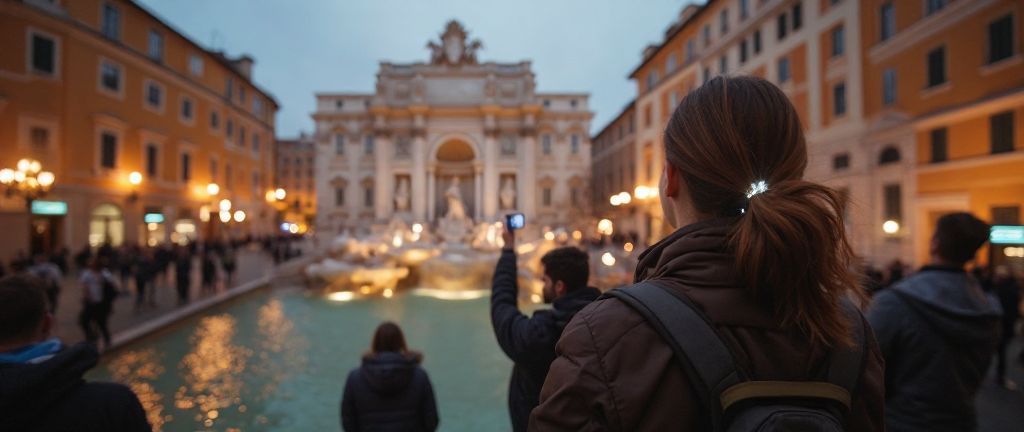
You’re standing in front of the Trevi Fountain at 6 AM, phone raised high above the sea of selfie sticks, trying desperately to get that one shot without hundreds of other tourists in the background.
You spent 30 minutes getting there in the dark; you’ll spend 5 minutes taking photos, and then you’re rushing off to the next “must-see” spot because your itinerary has 17 locations crammed into one day.
This is the travel trend that absolutely needs to stay in 2025: treating vacation like a competitive sport where the winner is whoever checks off the most boxes, collects the most content, and somehow manages to stay connected to work the entire time. This travel trend is one everyone should leave behind.
Understanding the Always-On, Content-First Travel Mentality
The Travel Trend Everyone Should Embrace for a Better Experience
The way we’ve been approaching travel over the past several years has fundamentally shifted from experiencing places to documenting them. There’s this really pervasive mentality that if you didn’t photograph it, geotag it, and share it within hours of it happening, did it even count?
And honestly, this mindset has completely transformed what should be restorative, mind-expanding experiences into exhausting content creation marathons.
The theoretical background here connects to what psychologists call “experience sampling” versus “experience living.” When you’re constantly interrupting genuine moments to capture them for an audience, your brain never fully engages with what’s actually happening. You’re experiencing everything through a lens, both literally and figuratively.
Research on memory formation shows that when we’re focused on documentation rather than participation, we actually retain less of the experience itself. The irony is that we’re creating all these external memory aids, photos, videos, stories, but forming fewer genuine internal memories.
This phenomenon has been compounded by the rise of the remote work culture. What started as an exciting opportunity to work from anywhere has morphed into an expectation that you should work from everywhere.
The laptop lifestyle sounds romantic until you’re sitting on a beautiful beach in Thailand, stressed about a Zoom meeting in three hours, and calculating time zone differences instead of actually enjoying the sunset.
The boundaries between work and vacation have become so blurred that many people return from trips feeling they never really left the office.
Practically speaking, this shows up in several really obvious ways. You book a trip to Paris, but you’re checking Slack notifications between bites of croissants.
You visit Machu Picchu, but you spend more time finding the perfect angle for your Instagram grid than actually sitting with the magnitude of where you are.
You plan every single hour of your itinerary because heaven forbid you “waste” time just wandering or resting. The trip becomes about optimization, efficiency, and output rather than genuine rest and discovery.
The challenges with breaking this pattern are significant because they’re largely self-imposed. Nobody is actually making you check your email on vacation except your own anxiety about falling behind. No one truly cares about your vacation photos as much as you think they do, but we’ve built entire self-worth narratives around social validation metrics.
The fear of missing out has been replaced by the fear of not being seen to be doing something impressive.
Why This Approach Fundamentally Fails
Let me be really clear about what happens when you treat travel like a productivity challenge or a content creation obligation: you miss the entire point of going somewhere new.
Travel, at its most basic, is supposed to expand your perspective. The whole reason people leave their homes and spend money to go somewhere unfamiliar is to get out of their routine, expose themselves to different ways of living, challenge their assumptions, and give their nervous system a break from its normal patterns.
When you’re operating in always-on mode, whether that’s always-on for work or always-on for content creation, you’re not actually traveling. You’re just relocating your regular stress to a prettier backdrop.
The productivity culture specifically has infiltrated travel in ways that are genuinely harmful. There’s this narrative that successful people work from exotic locations, that you can have both career advancement and adventures, that you should be answering emails from a cafe in Lisbon or taking calls from a villa in Bali.
And sure, technically you can do these things. But the mental load of maintaining work responsiveness while supposedly on vacation creates a state of perpetual semi-stress, leaving you never fully present in either role.
I’ve watched this play out repeatedly with people who plan these ambitious “work-cations,” thinking they’ll get the best of both worlds. What actually happens is they get a degraded version of both.
The work suffers because you don’t have your usual setup, rhythm, or full attention.
The travel suffers because you’re constantly mentally elsewhere, planning around wifi availability, and cutting experiences short to get back for a meeting.
The pressure to create content creates its own set of problems. When your primary relationship with a place is as a backdrop for your personal brand, you’re not engaging with it authentically.
You’re evaluating everything through the lens of “is this shareable?” You’re visiting places not because they genuinely interest you but because they’re recognizable or photogenic.
You’re creating a performance of travel rather than having actual experiences.
This approach also completely disregards the impact on destinations themselves. When millions of people descend on the same spots at the same time because that’s where the viral photos come from, it creates unsustainable crowding, damages local ecosystems, and turns genuine cultural sites into theme park versions of themselves.
The residents of Barcelona, Venice, and Santorini aren’t protesting tourism because they’re inhospitable people; they’re reacting to the very real ways that social media–driven tourism has degraded their quality of life and their cities.
How to Completely Restructure Your Travel Approach
The shift away from always-on, content-first travel means fundamentally restructuring your relationship with what travel is supposed to provide.
Establishing Genuine Boundaries Before Booking
This means having an honest conversation with yourself and your employer about what “time off” actually means. If you’re in a role where you truly cannot be unreachable for a week, then either your company has serious structural problems, or you’re wildly overestimating your own indispensability.
For most people, with proper planning and delegation, being genuinely offline for at least several days is entirely possible. This needs setting up out-of-office messages that don’t include your cell phone “for emergencies,” briefing colleagues on what they can handle in your absence, and wrapping up urgent projects before departure.
The important thing here is that you’re making these decisions proactively rather than leaving things ambiguous. When you’re vague about your availability, you end up feeling obligated to check in “just in case.” When you’re clear about being unreachable, you give yourself permission to actually disconnect.
Rethinking Your Itinerary Structure
Instead of planning what you’ll do every single hour, plan anchor points and leave massive amounts of unstructured time. Maybe you know you want to visit two or three specific places during a week-long trip, and that’s it.
The rest is open.
This feels uncomfortable initially because we’ve been conditioned to believe that good trip planning means having every moment accounted for. But the reality is that the most memorable travel experiences usually happen in the unplanned spaces, the restaurant you stumbled into because you were lost, the conversation with a local who gave you recommendations no guidebook mentioned, the extra hour you spent in a park because you finally felt relaxed enough to just sit.
When you over-plan, you eliminate the possibility of these spontaneous moments. You’re too busy rushing to the next scheduled thing to notice what’s actually around you.
Creating Intentional Friction Between Yourself and Content Creation
This doesn’t mean not taking photos, but it means establishing rules that prevent documentation from overtaking experience. One approach that works really well is to designate specific times for photos rather than constantly interrupting moments.
You might decide you’ll take photos during the first ten minutes at any location, and then the phone goes away.
Or you might have a rule that you experience something fully first, and only photograph it at the end if you still want to. The key is making documentation secondary to experience rather than the primary goal.
Some people find it helpful to bring a separate camera rather than using their phone, specifically because it removes the temptation to immediately post, check responses, or get pulled into other apps. There’s something really valuable about the delay between taking a photo and sharing it; it forces you to sit with the experience itself rather than immediately seeking external validation.
Practicing Strategic Disconnection
This means actively choosing when you’ll be connected rather than remaining constantly available. Maybe you check messages once per day, in the morning, for fifteen minutes.
Maybe you completely log out of your work email and put an away message directing people to your colleague.
Maybe you delete social media apps from your phone for the duration of the trip and reinstall them when you return.
The specific tactics matter less than the underlying principle: you are choosing when and how to engage with digital communication rather than remaining in a reactive mode. You’re taking back control instead of letting your devices dictate your attention.
Choosing Destinations and Timing Based on Different Criteria
Instead of going where everyone else is going at peak times, consider shoulder seasons, secondary cities, or lesser-known regions. To experience Italian culture, maybe skip Florence in July and visit Lecce in October instead.
If you’re drawn to Southeast Asia, perhaps explore Vietnam’s central highlands instead of adding to the crowds in Bangkok and Bali.
I’m not talking about being contrarian for its own sake; finding places where you can actually experience normal life, rather than a tourism industrial complex, makes the whole trip better. You interact with people who live there rather than other tourists.
You see how places actually function, rather than how they perform for visitors.
Common Mistakes During the Transition
The biggest mistake people make when trying to shift away from always-on travel is trying to change everything at once and then feeling guilty when they can’t maintain it. You’ve spent years developing these patterns of constant connectivity and documentation.
They won’t disappear overnight just because you’ve intellectually decided they should.
A lot of people set these absolute rules for themselves, “I won’t check my phone at all for seven days” or “I’m not taking a single photo this entire trip”, and then break them within twenty-four hours and feel like failures. The all-or-nothing approach rarely works for behavior change.
Starting with smaller adjustments works better.
Maybe your first try at more disconnected travel involves checking work messages once a day instead of constantly. That’s still a massive improvement, even if it’s not perfect.
Another common pitfall is underestimating the genuine discomfort of being less connected. If you’re someone who’s been constantly available for years, the feeling of being unreachable can initially trigger real anxiety. You might find yourself wondering what’s happening at work, whether anyone needs you, and if you’re missing something important.
This discomfort is normal and doesn’t mean you’re doing anything wrong. Breaking an addiction, because that’s essentially what this is, comes with a withdrawal period.
Sitting with that discomfort, rather than immediately relieving it by checking your devices, is part of the process.
People also often make the mistake of broadcasting their intention to disconnect, which creates its own form of pressure and performance. If you announce on social media that you’re doing a “digital detox vacation” and then post about how present and mindful you’re being, you haven’t actually disconnected; you’ve just changed what you’re performing.
The goal is to actually experience travel differently, not to be seen as someone who travels differently. Sometimes that means not announcing your plans at all and just quietly implementing them.
There’s also a tendency to blame external factors when this shift feels difficult. “My boss expects me to be reachable,” or “My industry needs constant availability,” or “People want to see my travel content.” While external pressures certainly exist, they’re rarely as absolute as we make them out to be.
Most of the time, we’re enforcing these expectations on ourselves and then attributing them to others. Yes, your boss might prefer if you answered emails on vacation, but will you actually be fired if you don’t?
Probably not.
Yes, your Instagram followers might engage with your travel content, but will they abandon you entirely if you post about your trip after you return rather than during? Definitely not.
Adapting This to Different Travel Styles and Constraints
The core principle of being more present and less performative in your travel applies regardless of your specific circumstances, but the implementation obviously varies.
If you’re traveling for work and genuinely need to maintain some level of connectivity, you can still establish boundaries. Maybe you schedule all your work tasks for morning hours and keep afternoons completely free for unstructured exploration.
Maybe you choose accommodations with dedicated workspaces so there’s physical separation between work mode and experience mode.
Maybe you build in extra days at the beginning or end of business trips specifically for personal exploration without work obligations.
For people traveling with children, the pressure to document everything can feel even more intense because you’re trying to preserve these family memories. But your kids will remember the trip based on how present you were, not how many photos you took.
They’ll remember whether you were genuinely engaged with them or constantly distracted by your phone.
You can absolutely capture important moments without it becoming the focus of the entire trip. Designating one family member as the photographer for each day can help distribute this responsibility and ensure everyone gets to be fully present at times.
If you’re traveling solo and using social media to stay connected with people back home or to feel safe by sharing your location, there are ways to maintain that safety function without the constant connectivity burden. You might share general updates every few days rather than posting in real time.
You might designate specific check-in times with family or friends rather than being in constant contact.
You can get the security benefits without the mental load of constant documentation.
Building Toward Genuine Travel Mastery
Understanding that travel should be restorative rather than performative is actually an advanced concept. It needs enough self-awareness to recognize that your current patterns aren’t serving you, enough confidence to opt out of what everyone else is doing, and enough discipline to maintain boundaries when the temptation to slip back into old habits is strong.
True travel mastery means having the wisdom to know what you personally need from travel and the ability to structure your trips accordingly. For some people at certain life stages, that might mean adventurous challenges and packed schedules.
For others, it might mean spending a week in one place, developing a routine, and actually resting.
Neither is objectively better; what matters is whether your approach aligns with your actual needs rather than external expectations.
This also builds on the understanding that experiences have inherent value independent of how others receive them. When you can visit a place, have a meaningful experience, and not immediately share it for validation, you’re operating from a much more grounded place.
You’re traveling for yourself rather than for an audience.
That internal orientation develops over time and with practice.
The ability to be truly present while traveling also translates into greater presence in your daily life. If you can learn to put your phone away for hours at a time while you’re exploring a new city, you can apply that same skill to being present with friends at dinner or focused during creative work.
The boundaries you establish while traveling can serve as templates for those in other areas.
People Also Asked
Can I travel without posting on social media?
Yes, and you might actually enjoy your trip more. Many people find that when they’re not constantly thinking about how to present their experiences to an audience, they engage more deeply with where they are.
You can always share photos and stories after you return if you want to; there’s no rule that travel content has to be posted in real-time.
How do I tell my boss I won’t be available on vacation?
Have a direct conversation before you leave where you explain that you’ll be completely offline, brief your colleagues on anything they need to handle in your absence, and set up clear out-of-office messages. Most employers will respect this boundary when you’re clear and proactive about it, rather than vague about your availability.
What is slow travel?
Slow travel means spending more time in fewer places rather than rushing through multiple destinations. Instead of visiting five cities in seven days, you might spend a full week in one place, developing routines, shopping at local markets, and actually getting a feel for how people live there.
This approach reduces travel stress and allows for deeper experiences.
How do I stop feeling FOMO when others are traveling constantly?
Remember that what people share on social media is a curated highlight reel, not their full experience. Someone posting beautiful travel photos might have been stressed and exhausted the entire trip.
Focus on what you actually want from travel rather than comparing yourself to others’ carefully edited presentations of their lives.
Is it rude not to take photos with locals?
Actually, many people in heavily touristed areas appreciate it when visitors treat them like regular people rather than props for photos. If you do want to photograph someone, always ask permission first and respect their answer.
Better yet, have genuine conversations without the camera creating a barrier between you.
How can I travel authentically?
Choose destinations based on genuine interest rather than social media trends; spend time in places beyond the main tourist sites; eat where locals eat; use public transportation; learn a few phrases in the local language; and be open to unplanned experiences. Authentic travel happens when you’re genuinely curious about a place rather than just checking boxes.
Which overtourism hotspots should I avoid?
Major overtourism destinations include Venice, Barcelona, Santorini, Dubrovnik, and Iceland’s most popular sites during peak summer months. If you do visit these places, consider going during shoulder season and exploring beyond the most photographed spots.
Better yet, research similar but less crowded choices in the same regions.
Key Takeaways
The always-on, content-first approach to travel that has dominated the past several years fundamentally undermines the purpose of travel itself. When you’re constantly connected to work, constantly documenting for an audience, and constantly optimizing every moment, you’re not actually traveling; you’re just relocating your regular stress patterns to different locations.
Creating genuine boundaries around work availability is essential for travel to serve its restorative function. This requires difficult conversations, careful planning, and the willingness to be truly unreachable, even when it’s uncomfortable.
Restructuring your approach means planning less, leaving space for spontaneity, and choosing experiences based on genuine interest rather than shareability. The most meaningful travel moments usually happen in unplanned spaces when you’re actually present as opposed to performing.
Breaking the documentation addiction needs intentional friction between yourself and constant content creation. Take photos, but keep them secondary to the experience rather than the primary goal.
Your memories matter more than your camera roll.
True travel mastery means knowing what you need and having the discipline to structure trips accordingly, even when that looks different from what everyone else is doing. Travel should expand your perspective and restore your energy, not exhaust you further.
Affiliate Disclosure for Smart Miles Traveler
At Smart Miles Traveler (https://smartmilestraveler.com), our goal is to provide helpful, honest, and practical travel tips, product recommendations, and money-saving strategies.
Some of the links on this website are affiliate links. This means that if you click on a link and make a purchase, we may earn a small commission at no extra cost to you.
These commissions help support the operation of this website and allow us to continue creating free, high-quality travel content for our readers.
Questions or Concerns
If you have any questions about our affiliate relationships or how this website operates, please feel free to contact us.
📧 Email: info@smartmilestraveler.com