

Choosing the right travel agent for your family vacation can feel as overwhelming as planning the trip itself. There are thousands of agents out there, from home-based independent planners to large agency chains, and they all claim they’re the best fit for your family. When choosing a travel agent for a family vacation, it’s essential to consider their experience and understanding of family needs.
In short, knowing what sets a truly great family travel agent saves you from disappointment and ensures you find someone who genuinely understands your needs. Focus on these distinctions to make a confident choice.
Tips for Choosing a Travel Agent for a Family Vacation
Travel agents vary widely in quality, and truthfully, some simply aren’t qualified to plan your family vacation. The agent who brilliantly coordinates romantic honeymoons to French vineyards might be completely out of their depth planning a Disney trip for your family of five with kids ranging from toddler to teenager.
Family travel specialists have developed expertise in a completely different skill set. They understand nap schedules, know which resorts have the best supervised kids clubs, can identify which European museums offer engaging children’s programming, and recognize that your 13 year old’s needs are vastly different from your 4 year old’s.
They’ve learned, both professionally and as parents, how to balance adult relaxation with keeping kids entertained without overstimulating anyone.
The best family travel agents also understand family relationships in ways general agents don’t. They know that traveling with in-laws needs different room arrangements than traveling with just your immediate family.
They recognize when parents need adult-only dining built into the itinerary versus when families want to eat together.
They can read between the lines when you say “we want a relaxing vacation” and understand whether you mean lying by a pool or having well-paced activities without rushing.
What’s really interesting is that many top family travel agents came to this niche after having frustrating experiences planning their own family trips. They recognized a market gap for someone who clearly understood the challenges of family travel beyond just booking hotel rooms with two queen beds. These agents often bring a personal enthusiasm to their work because they’ve lived the challenges themselves.
Do You Need a Family Travel Specialist?
Answer these questions to discover if a family travel agent could transform your vacation planning experience
Essential Credentials and Certifications to Look For
Ultimately, choosing a travel agent for a family vacation can make all the difference in ensuring a smooth and enjoyable experience for everyone involved.
When you’re vetting potential travel agents, credentials matter more than most people realize. The travel industry has legitimate certifications that separate trained professionals from hobbyists who signed up with a host agency last month.
The most recognized credential is CLIA (Cruise Lines International Association) certification, which demonstrates formal training in travel planning and conformance to industry standards. While CLIA focuses primarily on cruise expertise, its certification process covers broader travel planning principles that apply across several travel types.
For family travel specifically, look for agents who’ve completed specialized education programs through organizations like the Family Travel Association or destination-specific certifications, such as Disney’s College of Knowledge for Disney specialists. These programs take a close look at the unique considerations of traveling with children, from safety procedures to age-appropriate activity selection.
Remember: Accreditation and strong supplier relationships mean agents can access better rates and special perks, improving your travel experience. Consider these benefits when choosing your agent.
However, here’s what really matters beyond the letters after someone’s name: firsthand destination knowledge. An agent who’s personally traveled to the destinations they recommend brings invaluable insight that no certification program can provide.
This is where FAM (familiarization) trips become incredibly important.
Agents who’ve toured properties, tested kids clubs, and sampled restaurants speak authentically about what works for your family versus what only looks appealing in a brochure.
I’ve found that the best agents openly share their personal travel experiences and can describe particular details, like which villa category at a particular resort has the easiest beach access with a stroller, or which Roman museums have bathrooms convenient enough for potty-training toddlers. That level of granular knowledge doesn’t come from certification programs alone.
Specialization Versus General Knowledge
This is where choosing a travel agent gets really nuanced. You need to decide whether you want a specialist who knows one type of travel exceptionally well or a generalist who can handle various trip types with solid competence.
Specialists typically focus on specific destinations (such as all-inclusive Mexico resorts, African safaris, or European river cruises), travel styles (luxury, adventure, accessible travel), or brands (Disney, Sandals, Club Med). The advantage of working with a specialist is the depth of knowledge.
A Disney-focused agent knows which Epcot restaurants accommodate picky eaters, which Magic Kingdom FastPass strategies work best with young children, and exactly how Disney’s dining plans actually calculate out financially.
They’ve booked these trips so many times that they can anticipate problems before they occur and offer solutions you wouldn’t have thought to ask about.
Generalists grant flexibility across many destinations and travel styles. They’re valuable if your family takes varied trips, maybe Disney one year, a European tour the next, then a Caribbean beach vacation.
You build a relationship with one agent who learns your family’s preferences over time and can apply that knowledge throughout various trip types.
For your first time working with an agent, I’d honestly recommend starting with a specialist for your specific trip type. If you’re planning that complex two-week Italy trip, find someone who specializes in European family travel and has personally traveled throughout Italy with children.
If you’re booking a Disney vacation, work with an Authorized Disney Vacation Planner who books dozens of Disney trips annually.
By narrowing your criteria (choosing either a specialist or generalist), you streamline your search to agents who fit your unique needs. This focus saves time and boosts the chances of finding the right expert.
Independent Agents Versus Agency Affiliated Agents
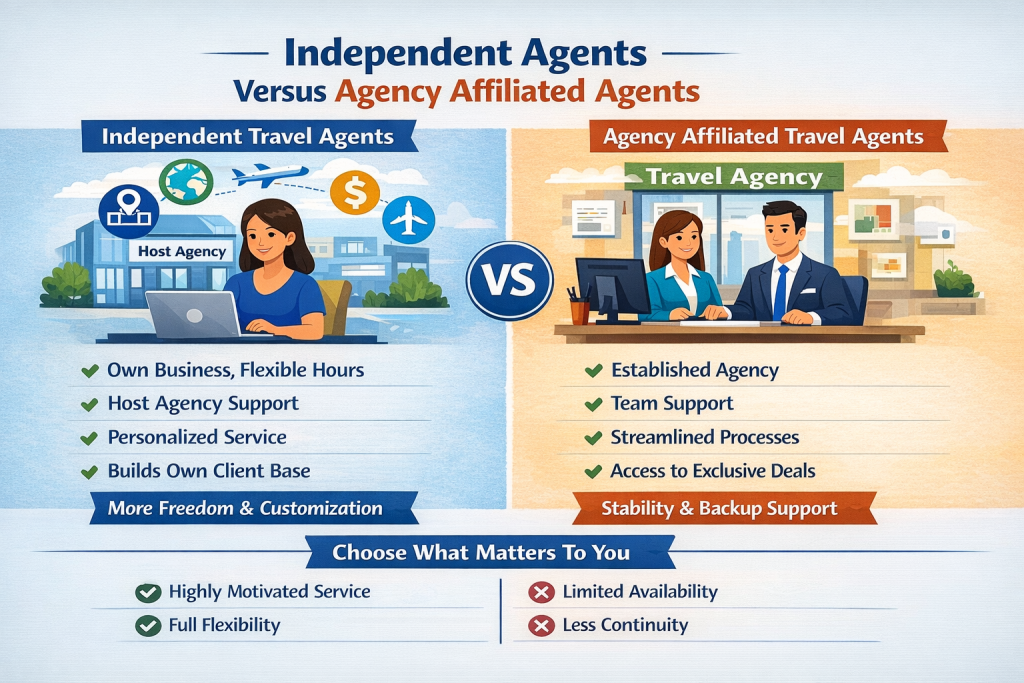
The travel industry’s structure can be confusing, so allow me to break it down clearly. Many travel agents work independently through what’s called a host agency.
The host agency provides back-end support, supplier relationships, booking technology, legal compliance, commission processing, while the independent agent builds their own client base and runs their business however they choose.
Other agents work directly for established travel agencies, either in physical storefront locations or as remote employees. These agents typically have more structured processes, established agency reputations, and team backup support.
Neither model is inherently better, but they offer different advantages. Independent agents often provide more customized service and greater flexibility in structuring their fees and tailoring your trip.
They’re building their own reputations, so they’re highly motivated to ensure exceptional service.
However, if your independent agent is unavailable during your trip or leaves the industry, you might lose your point of contact.
Agency-affiliated agents offer continuity and backup support. If your primary agent is unavailable, another agent at the firm can access your booking and help with any issues.
Established agencies often have stronger supplier relationships and higher sales volumes, which can translate to better perks for clients.
The trade-off is that you might get less personal attention, and the agent might need to follow agency policies that restrict flexibility.
Always ask about backup support policies up front. Knowing who to contact if your agent is unavailable protects your booking and provides peace of mind.
How are client files maintained if the agent leaves?
What happens to your booking if the agent’s relationship with their host agency changes? These aren’t pleasant questions, but they’re important ones that protect your investment and peace of mind.
Evaluating Communication Technique and Availability
This aspect is constantly overlooked, yet it’s absolutely critical to a successful agent-client relationship. You need an agent whose communication method aligns with your preferences and whose availability fits your timeline.
Some agents work primarily via email and respond within 24-48 hours. Others prefer phone conversations and prompt decision-making.
Some maintain strict business hours, while others check messages in the evenings and on weekends.
To avoid frustration, ensure your agent’s communication habits match yours. Set clear expectations early for a smoother planning experience.
During your initial consultation, pay attention to how the agent talks.
- Do they listen carefully to your needs, or do they immediately start pitching options before understanding your family?
- Do they raise thoughtful questions about your children’s ages, interests, and travel experience?
- Do they inquire about your budget parameters upfront, or do they avoid that conversation?
Response time during the planning process forecasts response time when problems arise during travel. If an agent takes three days to respond to your initial inquiry, they’ll likely take just as long when your flight gets cancelled, and you need rebooking help immediately.
This pattern of behavior doesn’t magically change once you’ve paid your deposit.
I really recommend being explicit about your communication preferences during the first conversation. Tell the agent, “I prefer email communication and typically check messages once a day” or “I’d like to have phone conversations for major decisions and email for minor details.” A good agent will adapt to your style.
An agent who insists on their preferred method regardless of your needs is showing you exactly how the relationship will function going forward.
Also, check the availability during your actual travel dates.
Will the agent be reachable if problems occur?
Do they have emergency contact procedures?
Some agents charge a premium for 24/7 travel support, while others include it as standard service. Know what you’re getting before you commit to working together.
Questions to Ask During Your Consultation
The initial consultation with a potential travel agent functions like a job interview, except you’re the employer deciding whether to hire them. Come equipped with specific questions that reveal their expertise and approach.
Start with questions about their experience: How long have you been planning family travel? How many trips similar to ours have you coordinated in the past year?
- Have you personally traveled to the locations we’re considering?
- What ages are your clients’ children typically? This establishes their relevant background and helps you gauge whether they actually have experience with families like yours.
- Move into questions about their process: How do you typically structure your planning timeline? What information do you require from us upfront?
- How do you handle budget discussions?
- What’s included in your service versus what would cost extra? Do you charge planning fees? If so, how are they structured?
These questions clarify expectations and disclose potential cost surprises that might arise later. Ask about their supplier relationships.
- Which properties or travel companies do you work with most frequently?
- Are you part of a consortium with preferred supplier relationships?
- Do those relationships influence your recommendations?
This helps you understand whether their suggestions are genuinely suitable or driven by commission incentives that benefit them more than you. Examine their problem-solving technique.
- Can you describe a challenging situation that occurred during a client’s trip and how you resolved it?
- What happens if we need to cancel or make major changes?
- What travel insurance do you recommend and why?
Their answers reveal how they handle adversity and protect clients when things go wrong.
Finally, ask for references.
Can you share contact information for two or three families who’ve taken trips similar to what we’re planning? Any agent confident in their service will readily provide references.
If they hesitate or refuse, that’s a notable red flag that should make you reconsider working with them. Pay attention not just to what they answer, but also to how they answer. Are they patient with your questions or dismissive?
Do they offer detailed explanations or vague generalities?
Do they admit when they don’t know something and need to research it, or do they bluff their way through? These details tell you everything you need to know about how the relationship will actually work.
Understanding Fee Structures and Pricing Transparency
Let’s talk about money, because this is where a lot of confusion and disappointment happen. Travel agent compensation varies widely, and knowing the structure upfront prevents unpleasant surprises.
Many agents work primarily on commission paid by suppliers, hotels, cruise lines, tour operators, and airlines. These commissions are built into the pricing, so, in theory, you pay the same whether you book directly or through an agent.
However, this model creates possible conflicts of interest.
An agent might recommend a higher-commission property over one that better suits your needs.
Increasingly, professional travel agents charge planning or service fees in addition to supplier commissions. These might be flat fees ($100-500+, depending on trip complexity) or hourly rates.
Some agents apply planning fees toward your booking if you proceed, while others keep the fees regardless.
Planning fees compensate agents for research and coordination time, particularly for complex itineraries that entail considerable customization.
Some agents use a hybrid model, charging modest planning fees plus earning supplier commissions. Luxury travel agents often charge a percentage-based fee (10-15% of the total trip cost) for highly customized, complex itineraries that require thorough coordination and insider access.
The key is transparency. Reputable agents clearly explain their fee structure upfront.
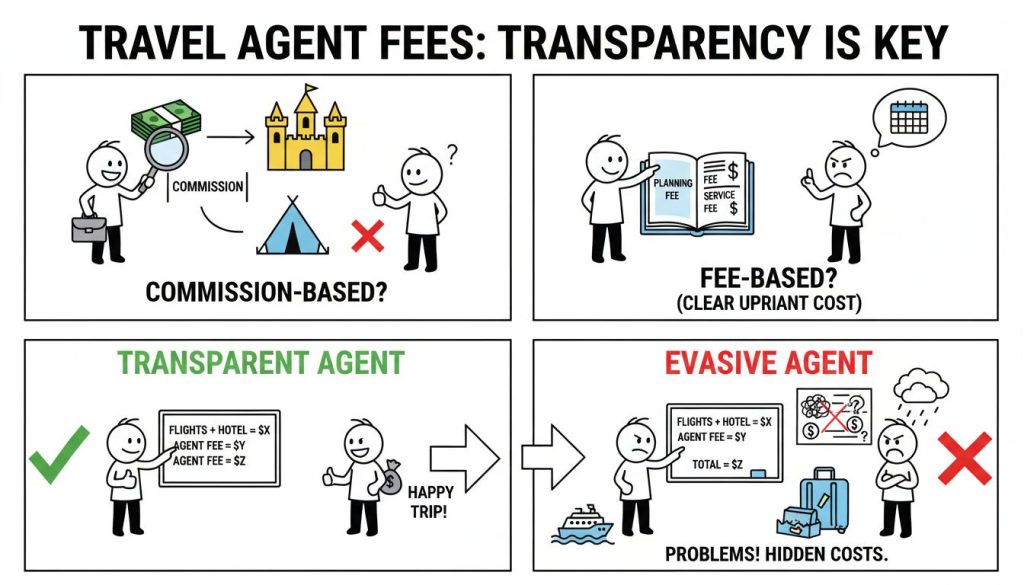
They itemize what you’ll pay them directly versus what’s included in your overall trip cost.
They disclose whether they receive higher commissions from certain suppliers and how that might influence recommendations.
During your consultation, ask explicitly: What will I pay you directly in fees? How else are you compensated for planning my trip?
If I decide not to book, what do I owe you?
What happens to fees if I need to cancel? Are there extra charges for changes or modifications?
Compare the agent’s pricing to what you’d pay if you booked independently for equivalent arrangements. Sometimes agent rates are better, sometimes they’re higher.
The question is whether the agent’s value, coordination, expertise, problem-solving, and time savings justify any price difference.
Often, the answer is yes, specifically for complex trips, but you need to make that calculation for yourself based on your budget and priorities.
Avoid agents who are evasive about fees or who refuse to explain their compensation structure. That lack of transparency will only create problems later when hidden charges appear or when you realize they’ve been steering you toward options that benefit them more than you.
People Also Asked
What does a family travel agent do?
A family travel agent specializes in planning vacations for families with children. They handle all booking logistics, including flights, accommodations, activities, and dining reservations, while factoring in family-specific factors, such as children’s ages, nap schedules, dietary restrictions, and age-appropriate activities.
They also provide support during travel if complications occur.
How much does it cost to use a travel agent for a family vacation?
Travel agent fees vary widely. Some agents work on supplier commissions only at no direct cost to you, while others charge planning fees ranging from $100-500+, depending on trip complexity.
Luxury travel agents may charge 10-15% of the total trip cost.
Always ask about the fee structure during your initial consultation.
Are travel agents worth it for Disney vacations?
Disney-specialized travel agents can provide significant value through their knowledge of park strategies, dining reservations, FastPass planning, and resort selection. Many Disney agents work on commission only, with no fees charged to clients, making them an affordable resource for navigating Disney’s complex booking system.
How do I find a good family travel agent?
Begin by asking friends with similar family arrangements for recommendations. Search for agents specializing in your destination type through professional organizations such as ASTA or consortia such as Virtuoso. Read the book Travel Agent Near Me: 12 Reasons to Work With a Travel Agent.
Review their websites and social media for client testimonials and evidence of firsthand destination knowledge.
Schedule consultations with several agents before making your decision.
Do travel agents get better prices than booking online?
Sometimes, travel agents access better rates through preferred supplier relationships and consortium memberships. They may also secure room upgrades, resort credits, or other perks not available to person bookers.
However, the value often comes more from their expertise and solution-oriented support than from lower base pricing.
What’s the difference between a travel agent and a travel advisor?
The terms are often used interchangeably, though “travel advisor” is increasingly preferred as it better reflects the consultative role these professionals undertake. Both plan and book travel, but the advisor title emphasizes the expertise and guidance they provide beyond simple booking.
Key Takeaways: Choose a travel agent whose specialization matches your specific trip type and who has firsthand knowledge of the destination. Evaluate their communication techniques, technology systems, and availability to confirm they align with your preferences.
Ask detailed questions about their fee structure, supplier relationships, and problem-solving method, and watch for red flags such as pressure tactics or a lack of transparency.
Consider the relationship as a possible long-term partnership that improves with each trip rather than just a one-time service transaction.
Affiliate Disclosure for Smart Miles Traveler
At Smart Miles Traveler (https://smartmilestraveler.com), our goal is to provide helpful, honest, and practical travel tips, product recommendations, and money-saving strategies.
Some of the links on this website are affiliate links. This means that if you click on a link and make a purchase, we may earn a small commission at no extra cost to you.
These commissions help support the operation of this website and allow us to continue creating free, high-quality travel content for our readers.
Questions or Concerns
If you have any questions about our affiliate relationships or how this website operates, please feel free to contact us.
📧 Email: info@smartmilestraveler.com