

I used to think family vacations were supposed to look a certain way: parents booking everything, kids tagging along without much say, everyone crammed into one hotel room to save money, and the whole trip planned around what adults thought children should experience.
As we explore the latest Family Vacation Trends, it’s evident that families are seeking more personalized experiences that cater to everyone’s preferences.
And truthfully? Those trips were exhausting.
The problem was that I was fighting against what my family actually wanted, rather than leaning into it. The moment I started really listening to what everyone needed, including letting my daughter suggest destinations she’d seen on YouTube, our vacations transformed completely.
Suddenly, we weren’t simply traveling together.
We were creating something meaningful.
Family Vacation Budget Planner 2026
Plan your family vacation budget based on 2026 trends. The average family now spends $8,052 on vacations, up 20% from previous years. Use this tool to estimate your costs across flights, accommodation, activities, and dining, then compare your budget to national averages.
Adjust percentages to customize your budget allocation. Recommended: 30% flights, 35% accommodation, 20% activities, 15% dining.
The Multi-Generational Movement That’s Changing Everything
Family travel right now is getting bigger, reflecting the evolving Family Vacation Trends. Families are dropping an average of $8,052 on vacations in 2025 (up 20% from the year before), but bigger in scope.
We’re talking three, sometimes four generations traveling together, and this has become genuinely mainstream.
The numbers tell a convincing story. Over half of parents, 57% specifically, are planning trips that include grandparents and children together.
That’s no longer a small niche.
And what’s particularly interesting is that 29% of families are embracing what’s called skip-generation travel, where grandparents take the kids without the parents.
I’ll be honest: when my mom first suggested taking my daughter to San Diego for a long weekend without me, I felt a strange mix of relief and guilt. But watching them come back with personal jokes and stories I wasn’t part of actually strengthened our family dynamic in ways I hadn’t anticipated.
The practical reality of multi-generational travel means you need destinations and accommodations that really work for everyone. A fifteen-year-old and a seventy-year-old grandmother obviously don’t have the same stamina or interests.
That’s why places like Prague, which have seen 180% growth in search interest for 2026, work so well.
You’ve got walkable historic districts, accessible cultural sites, quality restaurants at various price points, and activities that don’t require everyone to be in peak physical condition.
Connected hotel rooms have turned into essential infrastructure for these trips. Hilton’s been pushing these hard, and for good reason.
Everyone gets some privacy and independence, but you’re still close enough to coordinate easily.
This makes the difference between a trip that feels cramped and stressful versus one where everyone actually enjoys being together.
The psychological element matters here, too. Travel psychologists are pointing to the deep need families have to expand horizons and create authentic opportunities to share stories and memories across generations in what’s become an increasingly transactional, screen-dominated world.
We’re actively creating connections that don’t naturally exist in daily life anymore.
When Kids Start Making the Real Decisions
Children aren’t just passengers on family vacations anymore. They’re actively influencing where families go and what they do, and parents are encouraging this rather than resisting it.
The data is striking: 78% of parents say their children inspire them to seek out new travel experiences, and 73% of those traveling with kids expect to actively encourage them to join in vacation planning. This represents a basic change in how families view the planning process itself.
I started letting my daughter have real input when she was seven. Not just “would you rather go to the beach or the mountains,” but showing her destination options, reading reviews together, and letting her vote on activities.
What surprised me was how much more invested she became in the actual trip.
She wasn’t complaining that things were boring because she’d literally chosen half of what we were doing.
The practical application here needs actual tools, not just good intentions. Apps like Wanderlog let many family members contribute to itineraries and vote on activities.
Everyone can see the developing plan, suggest changes, and feel genuine ownership.
This eliminates the dynamic where one parent does all the planning and everyone else just shows up.
What this kidfluence trend really means is that family vacations are being built around multi-interest experiences rather than single-focus trips. You’re not choosing between “kid activities” and “adult activities” anymore.
You’re seeking destinations and experiences that honestly excite people of all ages.
The shift also affects where families travel. Kids aren’t pushing for the same destinations their parents would have chosen twenty years ago.
They’re watching travel content on YouTube and TikTok, seeing places like Sofia, Bulgaria, and Krakow, Poland, and saying, “That looks interesting.” Search data for these cities has exploded, up 136% and 106% respectively, and a significant portion of that interest is being driven by younger family members who are exposed to more different destinations than previous generations.
Why Experiences Beat Physical Souvenirs Every Time
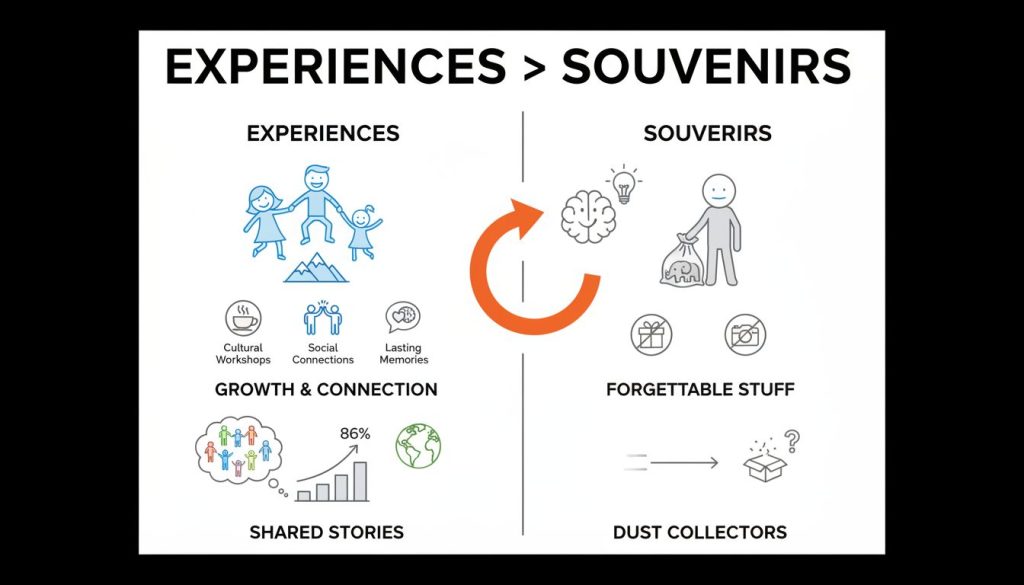
There’s a clear trend emerging. Families are spending money on experiences rather than buying things, and the gap is widening. 86% of travelers say they value experiences more than physical gifts, and 84% are specifically looking for opportunities for the entire family to play together.
Play, in this context, doesn’t just mean playgrounds and theme parks. Play means shared activities that create real engagement across age groups.
And interestingly, 58% of parents plan to enforce no-screen time during vacations, creating intentional spaces for this kind of connection.
The experience economy in family travel shows up in some really specific ways. Cultural workshops, for instance, have become incredibly popular.
Properties like Waldorf Astoria Costa Rica Punta Cacique offer coffee field tours with actual barista champions.
Zemi Miches in Punta Cana has artisanal workshops and mixology classes (non-alcoholic versions for kids, obviously). These aren’t passive tourist experiences where you’re being talked at.
They’re participatory, hands-on, and they create collective stories.
Adventure activities are seeing massive growth, too. Nearly 20% of global travelers cite sporting events and entertainment as their primary reasons for travel, and 63% report making new friends on event-based trips.
This social element, connecting with other families or locals around shared interests, adds a dimension that traditional sightseeing doesn’t provide.
What’s particularly compelling is how experiences naturally create more meaningful memories than acquisition-based travel. My family took a cooking class in Thailand a few years ago, and we still reference the techniques we learned as well as the jokes that came up during that three-hour session.
Meanwhile, the elephant pants we bought at the market?
Gone within six months, and nobody remembers them.
The other piece of this is intentional cultural involvement. 35% of those considering travel in 2026 are specifically interested in cultural experiences, and 31% are actively seeking local groups or communities to join rather than staying in the tourist bubble.
Companies such as Airbnb Experiences or Viator have made this much easier to arrange, providing curated, family-friendly cultural activities that let you join, rather than just observe.
The Technology That’s Actually Making Planning Easier
Permit me to be really clear, travel planning used to be absolutely brutal. You’d have seventeen tabs open, three different spreadsheets, a shared Google doc that nobody except you ever looked at, and by the time you’d coordinated flights, hotels, activities, and restaurants, you needed a vacation from planning the vacation.
AI trip planners are genuinely changing this, and not in a gimmicky way. These tools are sophisticated enough now that they can actually reduce the mental effort of planning rather than adding to it.
Mindtrip builds complete itineraries through conversational AI. You tell it your location, dates, interests, and budget, and it breaks down your trip from arrival at the airport to departure.
It suggests dining and activities, along with optimal timing, while considering realistic factors such as post-flight fatigue.
The map view lets you visualize your plan geographically, which is really important for avoiding the rookie mistake of booking activities on opposite sides of a city on the same day. You can export to calendar or PDF formats, depending on how your family likes to reference plans.
Wonderplan excels at flexibility, which is absolutely critical for family travel. If you’re mid-planning and decide to switch destinations, or if weather disrupts your schedule once you’re actually on the trip, it adjusts everything easily.
It also provides reliable budget estimates without assuming everyone wants luxury experiences, which is refreshing.
Most planning tools either assume you’re backpacking on $30 a day or staying at five-star resorts with no middle ground.
Wanderlog combines visual itinerary building with group collaboration features. Multiple family members can vote on activities, review detailed plans together, and remain in agreement.
It automatically imports reservation emails, eliminating the “where did I save that confirmation number?” panic.
The expense tracking feature is honestly a major advantage for group travel because it eliminates the awkward “who paid for what” conversations that can create tension.
Google Gemini integrates fluently into the Google ecosystem, which matters if your family already uses Google products. It offers real-time suggestions in Search and Maps, tracks hotel and flight prices, and features a conversational interface that seems natural.
The advantage here is that no extra app adoption is required.
Hopper specializes in flight and rental-car pricing, sending alerts months in advance when prices drop. For budget-conscious families, this tool alone can save hundreds of dollars.
I set up alerts for a trip to Portugal six months out, and when prices dropped $200 per ticket, Hopper notified me within minutes.
That $800 savings for my family of four paid for several nice dinners and a cooking class.
The smart approach is to combine tools based on your specific priorities. Use Mindtrip or Wonderplan for itinerary building, Hopper for flight deals, and Wanderlog for group coordination.
This integrated approach addresses the core pain points of travel planning: information overload and platform fragmentation.
Instead of doing everything manually across disconnected platforms, you’re letting specialized tools handle what they do best.
How to Spend Smart Without Sacrificing Quality
The average family is spending over $8,000 on travel, which is a significant investment. But the trend points toward strategic spending that focuses on high-value experiences while eliminating wasteful expenses.
This means getting really clear about what actually matters to your family and allocating resources accordingly. Some families care deeply about accommodation quality and will happily eat cheaper meals to afford a nicer place to stay.
Others would rather stay somewhere basic and spend more on activities and dining.
There’s no universal right answer, but there is clarity about your specific values.
Booking directly on property websites often avoids platform markups, particularly for accommodations where you plan to spend significant time. The savings might be modest per night, but over a week-long stay, they add up.
Plus, properties sometimes offer perks like free breakfast or room upgrades to direct bookers that you won’t get through third-party platforms.
Leveraging off-peak travel is probably the single most effective strategy for accessing premium properties and experiences at lower costs. The same resort that costs $400 per night in July might be $200 in October, and the experience quality is often better because there are fewer crowds.
If your family has any leeway around school schedules, this approach opens up significantly better options within the same budget.
The experience-over-stuff principle applies to spending decisions, too. Reducing spending on souvenirs while allocating more to activities like cooking classes, guided tours, or adventure activities means your money goes toward forming memories rather than accumulating objects.
My daughter doesn’t remember the stuffed animal we bought in Rome, but she vividly remembers making pasta from scratch with an Italian grandmother in her actual home.
Price-alert tools across many platforms help identify genuine deals rather than pricing that just appears low. Airlines and hotels use dynamic pricing that changes constantly, and tracking these fluctuations manually is basically impossible.
Setting up alerts and being ready to book when prices drop needs some advance planning, but the savings are considerable.
Free AI trip planners generate budget estimates for various accommodation types, from hostels to hotels to Airbnbs, while suggesting cost-saving activities like free walking tours or visiting local supermarkets, which is actually a fascinating window into local culture. These tools help you understand the realistic cost range for your destination before you’re locked into expensive choices.
Where Everyone’s Actually Going
Search data discloses some genuinely interesting patterns about 2026 destination trends. Traditional family destinations remain popular, but emerging locations are attracting significant interest.
Christchurch, New Zealand, has seen search interest up 200% compared to 2025. Prague is up 180%.
Sofia, Bulgaria, is up 136%.
Kraków, Poland, is up 106%. These aren’t random fluctuations.
They represent families actively seeking destinations that offer something different from the usual suspects.
The Middle East regions are seeing noticeable growth, too. Jordan and Egypt searches are both up nearly 50%.
These destinations offer incredible cultural richness, historical relevance, and relative affordability compared to European equivalents.
Petra in Jordan, for instance, provides an absolutely stunning experience that rivals anything in Europe at a fraction of the cost.
Caribbean alternatives are emerging as well. The Philippines, the Azores, and the Seychelles are all displaying significant growth in search traffic.
These destinations offer beach experiences free of the overdevelopment and crowds of traditional Caribbean hotspots.
The Azores, in particular, present stunning natural beauty, manageable crowds, and European infrastructure at prices considerably lower than those in mainland Europe.
What these trending destinations have in common is.
Walkability is critical for multi-generational groups. Cultural richness that aligns with the experience economy trend; affordability compared to traditional hotspots; smart budget allocation; and mixed-generation appeal, with amenities and experiences that work across age groups.
Families are seeking genuineness and value simultaneously. A trip to Sofia offers genuine cultural immersion, fascinating history, incredible food, and friendly locals at prices that allow families to upgrade other aspects of their vacation.
That combination is compelling in ways that another trip to an overcrowded, expensive, heavily-touristed destination just isn’t.
The emerging destination trend also connects to kidfluence. Kids exposed to multiple travel content are suggesting places their parents might never have considered. A teenager watching travel YouTube might see content about Krakow’s street food scene or Sofia’s communist-era architecture and say, “That looks interesting.” Parents who are open to these suggestions end up discovering destinations they genuinely enjoy.
The Surprising Comeback Nobody Saw Coming
Cruises are making a really major revival, and if you’d asked me five years ago, I would not have predicted this. But 21.7 million Americans are expected to cruise in 2026, up from 20.7 million in 2025.
That’s a million extra cruisers in a single year, which is strong growth.
For families specifically, cruises solve several genuinely difficult pain points. All-inclusive pricing reduces decision fatigue and eliminates budget surprises.

You know upfront what you’re spending, and you’re not constantly pulling out your credit card or calculating costs.
Multiple activity options meet different interests simultaneously, which is critical for multi-generational groups. Kids can do one thing, adults can do another, and you can coordinate meals without calling for constant togetherness.
Accommodation and transit coordination are completely eliminated. You’re not researching hotels in many cities, figuring out train schedules, or dealing with rental car logistics. You unpack once, and your accommodation moves with you.
For families managing many schedules and interests, this simplification is genuinely valuable.
Multi-generational groups can book connecting cabins and coordinate meals while maintaining independence. Grandparents get their own space, parents get their own space, and kids have their designated areas, but everyone can easily meet up for planned activities or meals.
This provides an impressive solution to the proximity-without-constant-togetherness balance that multi-generational travel needs.
The cruise resurgence indicates a wider interest in package travel that makes logistics easier. Families are increasingly willing to trade some flexibility for a significantly reduced planning burden, especially when the package quality has substantially improved from the stereotypical cruise experience of previous decades.
Your Actual Action Plan
Start by defining your multi-interest priorities with input from all family members. Involve everyone in identifying what matters most.
Cultural experiences, outdoor adventure, relaxation, food, specific activities, whatever genuinely excites your specific family.
Select destinations that offer meaningful options across these identified interests as opposed to forcing everyone into a single-focus trip.
Choose your planning tools strategically. Rather than relying on a single platform and forcing it to do everything, mix specialized tools.
Use Mindtrip or Wonderplan for initial itinerary building, Hopper for flight tracking, Wanderlog for group coordination, and reservation platforms like Booking.com or Airbnb with family-friendly filters for accommodations.
This consolidated approach lets each tool handle what it does best.
Leverage price-tracking technology months in advance. Set up alerts on Hopper, use Google Gemini’s price tracking, and enable notifications on your chosen reservation sites.
AI tools spot patterns and forecast optimal booking windows that you’d never catch manually.
This alone can save hundreds or thousands of dollars, depending on your trip size.
Plan collaboratively using shared itinerary tools that allow many family members to contribute. This addresses kidfluence while keeping adults organized and reducing the endless-text-threads coordination problem.
When everyone can see the developing plan and suggest changes in one central location, planning becomes genuinely collaborative rather than having one person do everything and hope others will be happy with the results.
Build flexibility into your itinerary rather than rigidly following every planned activity. AI tools like Wonderplan excel at instant adjustments.
If the weather disrupts plans or an activity isn’t resonating, pivot easily.
Extra time between activities prevents that rushed, stressed feeling that sabotages the entire purpose of a vacation.
Frequently Asked Questions
What is skip-generation travel?
Skip-generation travel refers to trips in which grandparents take their grandchildren on vacation without the parents. About 29% of families are now accepting this travel style, which allows grandparents and grandchildren to build stronger bonds while giving parents a break.
These trips often focus on activities and destinations that interest both the older and younger generations without needing to accommodate middle-generation preferences.
How much does the average family spend on vacation?
Families are spending an average of $8,052 on vacations in 2025, which represents a 20% increase from the previous year. This budget typically covers flights, accommodations, activities, dining, and other travel expenses.
The increase reflects both rising costs and families choosing to invest more in experiences than in material possessions.
What are the best AI travel planning apps for families?
Mindtrip excels at building complete itineraries through conversational AI and provides realistic scheduling that accounts for factors such as post-flight fatigue. Wonderplan offers excellent flexibility for mid-trip adjustments and reliable budget estimates.
Wanderlog combines visual planning with group collaboration features, allowing many family members to vote on activities and track shared expenses.
Hopper specializes in flight and rental car price predictions and alerts.
Is Prague good for family travel?
Prague has seen 180% growth in search interest for family travel in 2026 because it offers walkable historic districts, accessible cultural sites, quality restaurants at various price points, and activities suitable for many generations. The city works well for families because it doesn’t require everyone to be in peak physical condition to enjoy the main attractions, making it ideal for groups that include young children and older adults.
How do I involve my kids in vacation planning?
Start by showing children destination options and reading reviews together, rather than just asking basic preference questions. Use collaborative planning apps like Wanderlog that allow kids to vote on activities and see the developing itinerary.
Give them genuine decision-making power over certain aspects of the trip, which increases their investment and reduces complaints during the actual vacation.
Research shows 73% of parents traveling with kids actively encourage them to join in planning.
Are cruises making a comeback for families?
Yes, cruises are undergoing significant growth, with 21.7 million Americans expected to cruise in 2026, up from 20.7 million in 2025. For families, cruises solve several pain points: all-inclusive pricing eliminates budget surprises, many activities cater to different interests, and you unpack once while your accommodation moves with you.
Multi-generational groups particularly benefit from connecting cabins that provide both proximity and independence.
What emerging destinations are families searching for?
Christchurch, New Zealand, has seen 200% growth in search interest; Prague is up 180%; Sofia, Bulgaria, is up 136%; and Krakow, Poland, is up 106%. These destinations offer walkability, cultural richness, and affordability in comparison to traditional hotspots.
Middle East regions like Jordan and Egypt are also seeing nearly 50% growth, offering incredible cultural experiences at lower costs than European equivalents.
How far in advance should I set up price alerts for family travel?
Set up price alerts at least six months in advance for the best savings. Tools like Hopper can track flight and rental car prices and inform you within minutes when prices drop significantly.
For a family of four, this advance planning can save hundreds or even thousands of dollars, which can then be reallocated to activities and experiences during your trip.
Key Takeaways
Family vacation trends for 2026 reflect basic shifts in how families travel. Multi-generational trips involving three or more generations have gone from niche to mainstream, with 57% of parents planning trips that include grandparents and children.
Skip-generation travel, where grandparents take kids without parents, accounts for 29% of family trips.
Children are actively influencing travel decisions, with 78% of parents saying their kids inspire them to seek new experiences. This kidfluence means families build vacations around multi-interest experiences that excite people of all ages simultaneously, rather than forcing everyone into single-focus trips.
Families value experiences instead of material possessions, with 86% valuing experiences more than physical gifts and 58% planning to enforce no screen-time moments during vacations. Cultural workshops, adventure activities, and participatory experiences create common stories that last far longer than physical souvenirs.
AI trip planning tools have matured enough to genuinely simplify the planning process. Tools like Mindtrip, Wonderplan, Wanderlog, and Hopper each handle particular aspects of travel planning, and combining them strategically addresses information overload while maintaining realistic budgets.
Emerging destinations like Prague, Christchurch, Sofia, and Krakow are attracting significant search interest for their walkability, cultural richness, and value. These locations work well for multi-generational groups because they deliver diverse activities without requiring peak physical condition.
Cruises are experiencing a comeback with substantial year-over-year growth, solving logistics challenges for multi-generational groups through all-inclusive pricing, diverse activity options, and simplified accommodation coordination.
Affiliate Disclosure for Smart Miles Traveler
At Smart Miles Traveler (https://smartmilestraveler.com), our goal is to provide helpful, honest, and practical travel tips, product recommendations, and money-saving strategies.
Some of the links on this website are affiliate links. This means that if you click on a link and make a purchase, we may earn a small commission at no extra cost to you.
These commissions help support the operation of this website and allow us to continue creating free, high-quality travel content for our readers.
Questions or Concerns
If you have any questions about our affiliate relationships or how this website operates, please feel free to contact us.
📧 Email: info@smartmilestraveler.com