

I used to believe that responsible parenting meant anticipating every possible scenario. That philosophy translated into suitcases packed with “just in case” items that never left their bags.
Three jacket options. Backup shoes for the backups.
Enough snacks to sustain a small village.
I’d spend the first day of every family vacation exhausted from hauling excessive luggage, paying overweight baggage fees, and organizing belongings across many hotel rooms.
One particularly disastrous trip to Barcelona changed everything. I actually injured my shoulder wrestling an overstuffed suitcase down a narrow staircase.
That moment made me realize my packing approach was actually causing the very stress I hoped to avoid. Key takeaway: Overpacking undermines relaxation and simplicity.
I wasn’t protecting my family from inconvenience, I was creating it.
The psychology behind overpacking runs deeper than simple preparation anxiety. We conflate quantity with security, assuming that more options lead to better outcomes.
For parents, this impulse intensifies because we’re managing the unpredictable needs of small humans who might spill, grow, or suddenly develop strong opinions about before acceptable clothing.
Learning to pack light for family travel means reevaluating what is truly essential. Key takeaways: Most destinations offer the solutions you need; packing less leads to less stress, easier mobility, and greater satisfaction.
Now, shifting from pre-trip stress to hands-on strategy, let me walk you through the framework that transformed my family’s travel experience from logistical nightmare into something genuinely manageable.
Understanding Your Actual Consumption Patterns
Before you can pack efficiently, you need honest data on what your family actually uses while traveling. Most parents operate on theoretical assumptions rather than empirical evidence.
When I started documenting our clothing usage, I uncovered that my children wore about 60% of what I packed. The remaining 40% served as psychological comfort blankets for me, not functional necessities for them. That elaborate outfit I packed for a potential nice dinner?
Never worn, because after a full day of sightseeing, nobody wanted formal dining.
The third pair of shoes per child? Completely redundant.
Track your next weekend trip meticulously. Photograph what everyone wears each day.
Note which items stay untouched in bags.
This reveals your family’s genuine consumption patterns rather than imagined scenarios. Most families find out that they can comfortably operate with half their typical packing volume once they confront actual versus projected needs.
The destination matters tremendously here. A week in Tokyo needs different considerations than a week at a beach resort, obviously.
But the underlying principle remains the same: research what your destination actually offers.
Most developed areas have pharmacies, grocery stores, and clothing retailers. You’re visiting places where millions of people live their entire lives with access to goods and services.
This realization changed my packing mindset: I was preparing for everyday life in a new place, not survival mode. Key takeaway: Adjust expectations to match realistic needs for the destination.
The Capsule Wardrobe Approach for Families
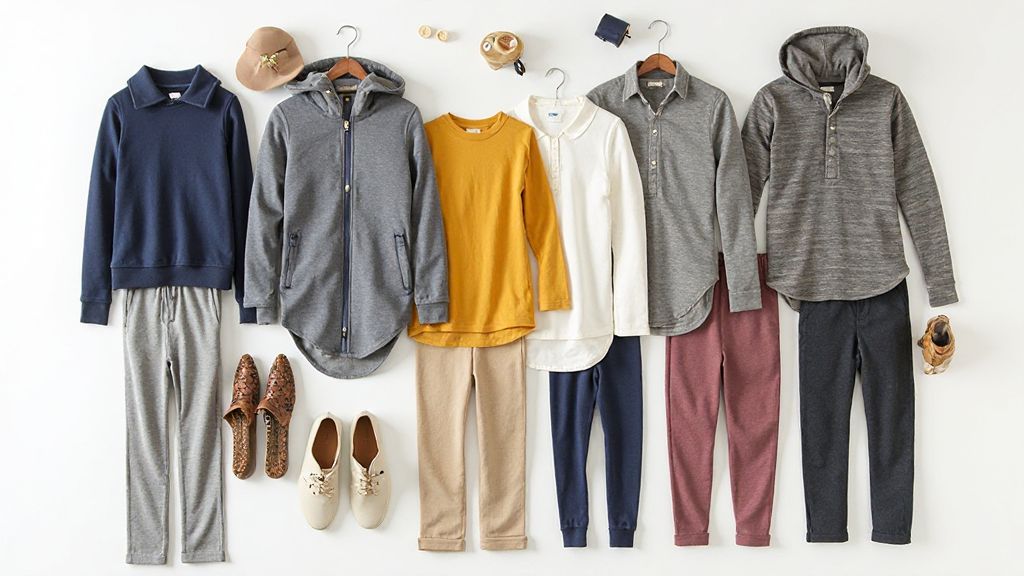
The capsule wardrobe concept, where every item coordinates with every other item, becomes genuinely transformative once you actually apply it.
Select a neutral color palette for each family member. For children, this might be navy, grey, and one accent color like red or yellow.
Every top works with every bottom.
This reduces decision fatigue and maximizes outfits. Key takeaway: A small, coordinated wardrobe creates exponentially more choices and less stress.
The fabric selection matters more than quantity. Modern technical fabrics that wick moisture, resist wrinkles, and dry quickly outperform traditional cotton in virtually every travel scenario.
I’ve replaced most of my children’s travel wardrobes with merino wool blends and synthetic performance fabrics.
These materials can be worn many times between washes without developing odor, unlike cotton, which becomes unwearable after a single day.
This answers the quantity question. Key takeaway: When clothes can be reworn, fewer items are needed, simplifying travel.
For a week-long trip, I now pack four outfits per child instead of seven, knowing they’ll wear each item many times and that I’ll do one mid-trip laundry session.
The layering principle applies universally across climates. Pack base layers, mid-layers, and outer layers that mix for warmth or separate for cooling.
A lightweight merino wool long-sleeve shirt, a fleece mid-layer, and a packable rain jacket accommodate temperature variations from 50-75 degrees Fahrenheit when combined strategically.
For children specifically, prioritize comfort over style. That adorable outfit with buttons, zippers, and complex closures creates bathroom emergencies and dressing struggles.
Simple, comfortable clothing that children can manage on their own means less intervention and more independence. Key takeaway: Choose independence over style for less friction.
Strategic Gear Consolidation
The gear category offers the greatest opportunity for weight reduction, as families typically pack redundant single-purpose items rather than seeking multifunctional choices.
Consider toiletries, which somehow multiply exponentially when packing for families. The full-size shampoo, conditioner, body wash, face wash, lotion, and sunscreen bottles consume a massive amount of luggage volume while rarely being fully used during trips.
Switching to solid alternatives, such as shampoo bars, solid sunscreen, and solid lotion bars, reduces volume by roughly 70% while eliminating liquid restrictions and leak concerns.
I’ve consolidated our family’s toiletries into a single quart-sized bag that accommodates four people for a week. The secret is to accept that hotel amenities suffice for basic needs while carrying only specialized items that genuinely matter.
My daughter needs a specific eczema cream.
That’s essential. The seventeen other lotions I used to pack?
Completely unnecessary.
For baby gear specifically, the rental-versus-pack calculation deserves serious analysis. Checking a full-size stroller costs nothing on most airlines, but creates connection stress and baggage claim delays.
Renting a stroller at your destination through services like BabyQuip costs $30-60 weekly, delivers equipment directly to your accommodation, and eliminates all transportation hassle.
For occasional travel, this makes mathematical and logistical sense.
The exception involves the gear your child particularly attaches to. Sleep training experts consistently recommend maintaining familiar sleep environments during travel, so if your toddler needs their specific sleep sack or comfort item, it’s genuinely essential, even if it adds extra weight.
Mastering Compression Without Distortion
Compression tools, cubes, bags, and vacuum systems help manage volume, but they’re often misapplied. Compression should efficiently consolidate packed items without encouraging overpacking.
I use packing cubes to organize by category rather than compressing volume. One cube contains all shirts, another contains all bottoms, and a third contains underwear and socks.
This organizational system means anyone in the family can locate specific items without disrupting the entire suitcase.
The modest compression that cubes provide happens naturally through organized folding.
The rolling versus folding debate continues endlessly in travel communities. I’ve tested both extensively.
Rolling creates fewer creases for casual clothing while maximizing space efficiency.
Folding works better for structured items like button-up shirts or dresses. The optimal approach combines both methods based on garment characteristics rather than adhering to a single technique.
For significant compression, vacuum bags work remarkably well for bulky items like jackets or fleece layers. The dramatic volume reduction allows winter coats to fit in carry-on luggage.
The tradeoff involves wrinkles and the need for vacuum access at your destination if you’re using reusable bags.
For one-way compression, packing light outbound and bringing items home, disposable vacuum compression bags solve this elegantly without requiring equipment.
The key takeaway from compression is whether your packing is appropriate. If you require extreme compression to make things fit, it indicates you’re likely attempting to pack too much.
Compression should improve organizational efficiency and modestly reduce volume, not enable fitting two suitcases’ worth of items into one.
Managing Different Age Groups Simultaneously
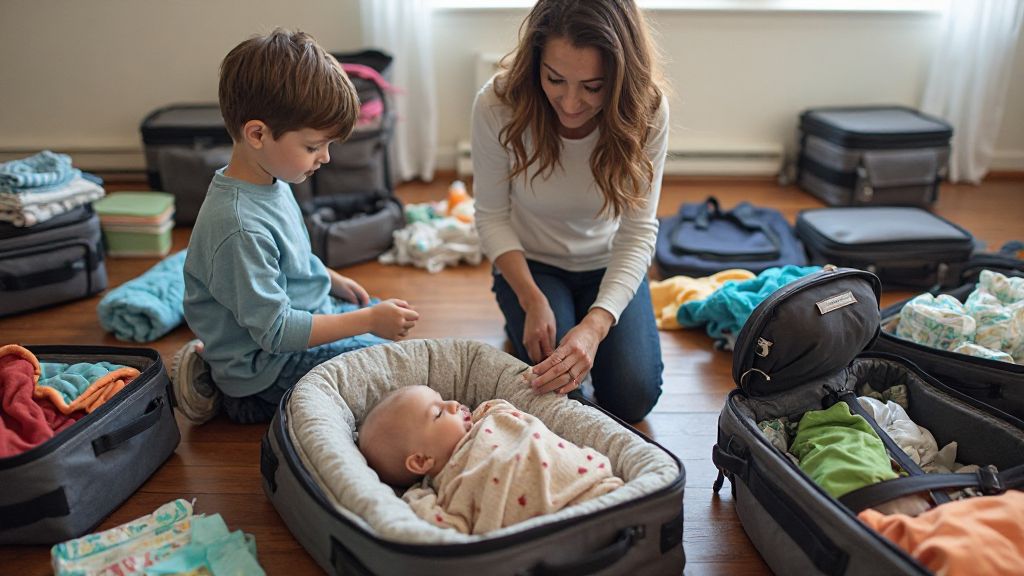
Packing for a family with children spanning different ages presents unique challenges because their needs diverge considerably. An infant needs completely different provisions than a seven-year-old, yet you’re managing everything simultaneously.
Create separate packing lists for each child based on their developmental stage. For infants, the list prioritizes consumables, diapers, wipes, formula or food, plus minimal clothing since they’re not walking through dirt.
For toddlers, the emphasis shifts toward durable play clothing and substantial snack provisions.
For school-age children, entertainment options and modest clothing selections dominate.
I’ve found success giving older children (typically ages 6+) ownership of their own small backpack. They choose specific toys, books, or activities they want for the trip within the weight and volume parameters I establish.
This builds their decision-making capabilities while reducing my mental load.
They’re good at self-regulating when given some autonomy. Key takeaway: Granting children packing responsibility relieves your own load and empowers them.
For families with infants, the diaper and wipe calculation deserves attention. A week-long trip might require 50-60 diapers for a young infant.
That’s significant weight and volume.
Rather than packing the entire supply, I now pack three days’ worth and purchase extra supplies upon arrival. Nearly every destination worldwide sells diapers and wipes.
The hour spent locating a pharmacy or grocery store yields substantial packing space while providing a low-stakes cultural experience.
The exception involves highly specific needs. If your child needs a particular hypoallergenic formula or specialized medical supplies, pack the full supply with a buffer. Attempting to source specialized items in unfamiliar locations creates unnecessary stress.
Laundry Strategy as Packing Philosophy
Accepting that you’ll do laundry during vacation fundamentally changes packing calculations. Yet many families resist this approach, viewing vacation laundry as an unacceptable burden.
I’ve reframed laundry from a chore to a strategic advantage. A single load mid-trip, which needs about 45 minutes of actual attention spread across several hours, enables packing half the clothing volume.
That translates to smaller luggage, lower baggage fees, easier mobility, and less organizational complexity.
Most accommodations offer laundry facilities or services. Vacation rentals typically include washers.
Hotels offer laundry services, though often at premium pricing.
Laundromats are found in virtually every populated area of the world. Even hand-washing in hotel sinks works effectively for small loads with quick-dry fabrics.
I schedule laundry strategically during natural downtime. Rainy afternoons, post-beach-cleanup times, or early evenings when children watch shows are laundry windows.
This feels less burdensome than carving out dedicated time because it overlaps with existing downtime.
The quick-dry fabric selection I mentioned earlier becomes crucial here. Technical fabrics dry completely overnight when hung on shower rods or balcony railings.
Cotton stays damp and develops that characteristic musty smell.
This material choice directly enables the reduced-packing, mid-trip-laundry approach.
Some families hire laundry services during longer vacations, treating it as worthwhile outsourcing rather than a vacation violation. A service that collects, washes, folds, and returns your family’s laundry for $30-50 provides exceptional time-to-money value compared to spending hours managing it yourself.
The 5-4-3-2-1 Packing Formula
After years of experimentation, I’ve settled on a simple formula that works for most week-long family trips in moderate climates: 5 tops, 4 bottoms, 3 pairs of socks, 2 pairs of shoes, 1 jacket.
This creates enough variety for a week while enabling mid-trip laundry. The specific items vary by destination and personal preferences, but the numerical framework provides helpful constraints that prevent overpacking while ensuring adequate clothing.
For trips shorter than a week, reduce proportionally. For trips longer than a week, maintain the same numbers and plan for laundry.
The common mistake involves linear scaling, thinking a two-week trip needs twice the clothing.
That’s mathematically unnecessary and logistically burdensome.
Young children need modest increases in this formula due to increased spilling and soiling. I typically pack 6-7 tops and 5 bottoms for toddlers, knowing that meals and playground activities create legitimate clothing casualties that adults avoid.
Undergarments and socks deserve separate consideration because they’re small, lightweight, and genuinely needed daily. I typically pack 7 pairs, even for week-long trips, accepting the modest volume increase for the convenience of not having to wash undergarments mid-vacation.
This formula assumes you’re packing clothing you actually like and feel comfortable wearing repeatedly. If you’re packing items you tolerate rather than enjoy, you’ll often resist wearing them and feel deprived by limited options.
The capsule wardrobe concept I mentioned earlier addresses this by ensuring that every item in your pack meets your quality and comfort standards.
Footwear Minimalism
Shoes occupy disproportionate luggage space while offering limited versatility. Yet families routinely pack 3-4 pairs per person for week-long trips.
The mathematical reality: you can wear one pair. That pair occupies no luggage space.
Each extra pair creates a weight and volume burden.
The optimal packing strategy, therefore, minimizes extra shoes while maximizing the versatility of the pairs you include. For most family travel, each person needs exactly two pairs: the ones worn during travel (typically athletic shoes or supportive walking shoes) plus one alternate pair packed in luggage.
For children, that alternate pair might be sandals for beach destinations or casual shoes for other locations.
The exceptions are genuinely specialized activities. Beach vacations where water shoes prevent injury on rocky shores warrant packing specific water footwear.
Winter destinations obviously require suitable boots.
But general travel rarely needs the variety we habitually pack.
I’ve embraced wearing our bulkiest shoes during travel days. This places the highest-volume items on feet rather than in bags, immediately reclaiming significant packing space.
Yes, wearing hiking boots through airports feels slightly absurd, but the luggage space saved exceeds the modest social awkwardness.
For children specifically, rapid growth creates financial pressure to buy budget footwear. Resist that temptation for travel shoes.
Quality, supportive footwear that fits properly prevents foot pain and blisters that derail vacation enjoyment.
One pair of quality athletic shoes serves better than three pairs of mediocre ones.
Common Packing Mistakes That Create Problems
Certain packing errors consistently create vacation problems beyond simple inconvenience. Learning to avoid these improves the entire travel experience.
Packing new, unworn shoes or clothing for vacation sounds appealing, fresh items for fresh experiences. This routinely backfires because you discover fit or comfort issues at the worst possible time.
That adorable new dress that seemed perfect in the store becomes uncomfortable after a full day of wear.
Those new shoes cause blisters during long walks. Only pack items you’ve worn successfully many times at home.
Neglecting to verify baggage allowances before packing can lead to expensive surprises at the check-in counter. Airlines vary widely in their baggage allowances, and budget carriers often charge more for checked bags than for the fare itself.
Design your packing around your specific airline’s restrictions rather than generic assumptions.
Failing to separate essential items creates vulnerability to bag delays or loss. Your carry-on should contain everything you’d need for 24-48 hours if checked luggage disappeared: medications, one change of clothes per person, critical toiletries, and valuable electronics.
Treat checked bags as holding only items you could temporarily do without.
Over-reliance on packing aids, cubes, compression bags, and organizers sometimes obscures the basic problem of packing too much. These tools should organize appropriately sized loads, not enable fitting excessive amounts.
If you’re struggling to fit everything, even with compression tools, you’re likely packing more than necessary.
Building This Into Sustainable Habits
The real challenge comes from building systems that make light packing your default, rather than an aspirational exception you occasionally achieve.
I maintain a master packing list that I refine after every trip. When I find out that I didn’t use something, I note that.
When I wished I’d packed something, I added it.
This evolving document reflects our family’s actual patterns rather than theoretical assumptions. After several trips, patterns emerge clearly.
I also keep a dedicated travel bag for toiletries and accessories that stays packed between trips. This eliminates the repetitive work of assembling the same items repeatedly.
When we return from vacation, I restock any consumables, and the bag stands ready for the next departure.
This small systematization saves hours annually while ensuring nothing gets forgotten.
For families who travel often, maintaining a separate travel wardrobe, clothing specifically designated for trips, streamlines packing because those items stay together. This works especially well for children’s travel clothing made from quick-dry fabrics that you might not use at home.
The mindset shift ultimately matters more than specific tactics. You’re preparing for possible experiences while recognizing that destinations offer resources to address unexpected situations.
This philosophical adjustment reduces packing anxiety and enables the practical strategies that actually improve travel experiences.
Frequently Asked Questions
How many outfits should I pack for a 7-day trip?
For most moderate-climate destinations, pack 4-5 outfits per person for a week-long trip. With mid-trip laundry, this provides more than enough clothing without excessive luggage weight.
Technical fabrics that can be worn many times between washings reduce the amount needed even further.
What are the best packing cubes for family travel?
Look for medium-sized cubes with mesh tops for visibility. Color-code by family member so anyone can quickly locate belongings.
Avoid compression cubes unless packing bulky items like jackets, as regular cubes provide enough organization without enabling overpacking.
Should I pack full-size toiletries or buy travel-sized products?
Switch to solid toiletries like shampoo bars and lotion bars. These eliminate liquid restrictions, prevent leaks, last longer than you’d expect, and take up significantly less space than bottled products.
For items you genuinely need in liquid form, refillable travel bottles work better than constantly buying disposable travel sizes.
How do you pack light with toddlers who make messes?
Pack 1-2 extra outfits beyond what you’d pack for older children, choose dark colors that hide stains, and embrace mid-trip laundry. Quick-dry fabrics mean you can rinse items in the sink and have them ready by morning.
Accept that some clothing casualties will happen, and that’s fine.
Can you really pack carry-on only for a family vacation?
Yes, for trips up to two weeks with school-age children or older. Infants and toddlers require more supplies, making carry-on-only travel challenging.
The key involves commitment to laundry, strategic capsule wardrobes, and accepting that you’ll purchase certain consumables at your destination rather than packing them.
What’s the best way to pack shoes in luggage?
Wear your bulkiest pair during travel days. For packed shoes, stuff them with socks or small items to maintain shape and maximize space efficiency.
Place shoes in shower caps or plastic bags to keep them separate from clean clothing.
Limit each person to one packed pair beyond what they wear.
How do you pack for different climates on one trip?
Use layering systems rather than packing different outfits for each climate zone. A base layer, mid-layer, and waterproof outer layer can be combined or separated to handle temperatures from 50 to 75 degrees.
Pack one climate-specific item, if needed, such as a warm fleece for cold destinations.
Should I pack a full first-aid kit for family travel?
Pack prescription medications, any essential over-the-counter items your family specifically uses, and basic bandages. Most destinations have pharmacies where you can purchase extra supplies if needed. A compact first-aid kit should fit in a quart-sized bag rather than occupying significant luggage space.
Key Takeaways
Light packing for families succeeds through strategic consolidation rather than deprivation. Track your actual clothing usage to reveal the gap between what you pack and what you use.
Build capsule wardrobes in coordinated colors where every item works together.
Embrace technical fabrics that can be worn many times between washings. Accept mid-trip laundry as a strategic advantage that enables packing half the clothing volume.
Apply the 5-4-3-2-1 formula as a practical starting framework.
Maintain comfort objects and essential medications while cutting ruthlessly elsewhere. Use organizational systems like color-coded packing cubes that work for your entire family.
Learn from each trip by refining your master packing list based on actual usage patterns.
Affiliate Disclosure for Smart Miles Traveler
At Smart Miles Traveler (https://smartmilestraveler.com), our goal is to provide helpful, honest, and practical travel tips, product recommendations, and money-saving strategies.
Some of the links on this website are affiliate links. This means that if you click on a link and make a purchase, we may earn a small commission at no extra cost to you.
These commissions help support the operation of this website and allow us to continue creating free, high-quality travel content for our readers.
Questions or Concerns
If you have any questions about our affiliate relationships or how this website operates, please feel free to contact us.
📧 Email: info@smartmilestraveler.com