

When I first started planning a long-term trip, everyone kept asking me the same question: “How much money do you actually need to travel for 6 months?”
The number $10,000 kept coming up in travel forums and budget breakdowns, but honestly, I wasn’t sure if it was realistic or just wishful thinking. Six months feels like a really long time to be on the road, and the idea of stretching ten grand across half a year felt both exciting and slightly terrifying.
Here’s what I’ve learned after taking a close look at this question and watching countless travelers try it:. $10,000 can absolutely cover six months of travel, but success depends entirely on where you go and how disciplined you are with your spending. You can’t just show up in Switzerland with that budget and expect it to work.
Pick the right destinations, travel with intention, and make smart choices about where you spend your money. That’s when the math actually starts to make sense.
The real challenge is understanding what you’re signing up for. This budget requires staying in shared dorm rooms with strangers, eating street food instead of restaurant meals, taking local buses instead of taxis, and sometimes skipping activities because they cost too much.
This requires discipline, flexibility, and a genuine willingness to embrace how locals actually live in the places you visit.
Why Geographic Selection Determines Everything
When I started breaking down the actual numbers, I realized that destination choice literally makes or breaks this entire plan. You could spend $10,000 in three months bouncing around Scandinavia, or you could stretch it to an entire year in parts of Southeast Asia.
The difference really is that dramatic.
Let’s talk specifics. In countries like Cambodia, Laos, and Vietnam, daily costs run about $15-20 if you’re traveling like a local.
That means eating street food, staying in basic guesthouses, and taking public transportation instead of taxis.
When you do the math on $15 daily, your $10,000 budget could theoretically last 666 days. Obviously, you’ll have other costs like flights and insurance, but this shows you just how far your money can stretch in certain regions.
Compare that to traveling through Japan or Australia, where even budget accommodations run $30-40 per night, and a simple meal easily costs $12-15. Your daily spending jumps to $60-80 at least, which cuts your travel time down to about four months before you’re completely broke.
And that’s if you’re still being really careful with your spending.
The reality is that choosing Southeast Asia, Central America, or parts of Eastern Europe gives you an entirely different financial playing field. These regions have well-established backpacker infrastructure, which means hostels, cheap local eateries, and affordable transportation networks designed specifically for budget travelers.
This infrastructure doesn’t really exist in expensive countries because there’s no market for it.
Budget travelers simply can’t afford to visit those places for extended periods, so the supporting economy never developed.
The Fixed Costs That Consume Your Budget Before Departure
Here’s something that really surprised me when I first started planning: the biggest chunk of your budget gets spent before you even arrive at your destination. International flights and travel insurance are what I call “fixed costs,” and they’ll consume anywhere from $2,000 to $3,700 of your $10,000 budget right off the top.
Let’s break this down realistically. If you’re flying from North America to Southeast Asia, you’re looking at $1,000-2,000 for a round-trip ticket, depending on when you book and how flexible you are with dates.
Book six months in advance, and you might snag something for $900.
Wait until the last minute, and you could easily pay $1,800 or more. That’s a $900 difference that directly impacts how many days you can actually travel.
Then there’s travel insurance, which absolutely cannot be optional when you’re traveling for six months. A comprehensive policy covering medical emergencies, trip cancellations, and lost belongings typically runs $600-700 for six months.
I know it feels like a lot of money to spend on something you hope you’ll never use, but trust me, one medical emergency or stolen passport without insurance, and your entire trip is finished.
After flights and insurance, you’re starting your actual travel with somewhere between $6,300 and $8,000. That’s your real budget for daily expenses over 180 days, which works out to about $35-44 per day.
Suddenly, that $10,000 doesn’t feel quite as generous anymore.
This is exactly why I always recommend that people think of their budget in two separate categories: fixed costs and daily spending. Your fixed costs are basically non-negotiable, since you need to get there and have insurance.
But your daily spending is where you have real control and flexibility.
What Daily Life Actually Costs in Budget Destinations
When you’re spending $35-44 per day, every single expense matters. Let me walk you through what a typical day actually looks like financially when you’re traveling on this kind of budget.
Accommodation will be your biggest daily expense, and this is where your comfort level really gets tested. In Southeast Asia, shared dorm rooms in hostels run about $4-10 per night. I’m talking bunk beds in rooms with 6-12 other travelers, shared bathrooms down the hall, and maybe a ceiling fan if you’re lucky.
Is it glamorous?
Absolutely not. But it’s clean, it’s safe, and it saves you an enormous amount of money compared to private rooms, which typically cost $15-30 in the same locations.
The beautiful thing about hostel culture is that it’s designed for exactly this type of travel. You’ll meet other people doing the same thing, share tips about cheap places to eat, and often end up with travel companions for the next leg of your trip.
Plus, many hostels include free breakfast, even if it’s just toast and coffee, so you don’t need to budget for another meal.
Food costs in budget destinations are genuinely incredible if you’re willing to eat local cuisine. Street food in Thailand, Vietnam, or Cambodia costs $1-3 per meal.
I’m talking about real, delicious food like pad thai, banh mi, fresh spring rolls, not just surviving on instant noodles.
You can easily eat three solid meals for $10-12 daily, and honestly, the street food is often better than what you’d get in tourist restaurants anyway.
The key is avoiding Western restaurants and tourist-focused cafes. That innocent-looking pizza place near your hostel is going to charge you $8-12 for something mediocre when you could be eating an amazing local dish for $2.
Those coffee shops with air conditioning and WiFi charge $4-5 for a latte when local coffee costs 50 cents.
These small choices add up incredibly fast.
Transportation within budget destinations is remarkably cheap if you’re using what locals use. In Bangkok, the metro costs about 40 cents per stop.
Intercity buses across entire countries run $8-15.
Even longer ferry rides to islands typically cost under $20. The expensive part is when you start taking taxis, booking private drivers, or flying between cities instead of taking overnight buses.
Activities and entertainment are where things get tricky, because they vary so widely depending on what you want to do. Many of the best experiences in Southeast Asia are completely free: temples, beaches, hiking trails, and local markets.
But if you want to go scuba diving, take cooking classes, or do organized tours, you’re looking at $20-100 per activity.
This is where you really need to prioritize what matters most to you.
The Slow Travel Strategy That Makes Everything Sustainable
I genuinely believe that slow travel is the secret to making a $10,000 budget sustainable. When you move locations every two or three days, you’re constantly spending money on transportation, paying single-night rates for accommodation, and wasting time figuring out where to eat instead of knowing the cheap local spots.
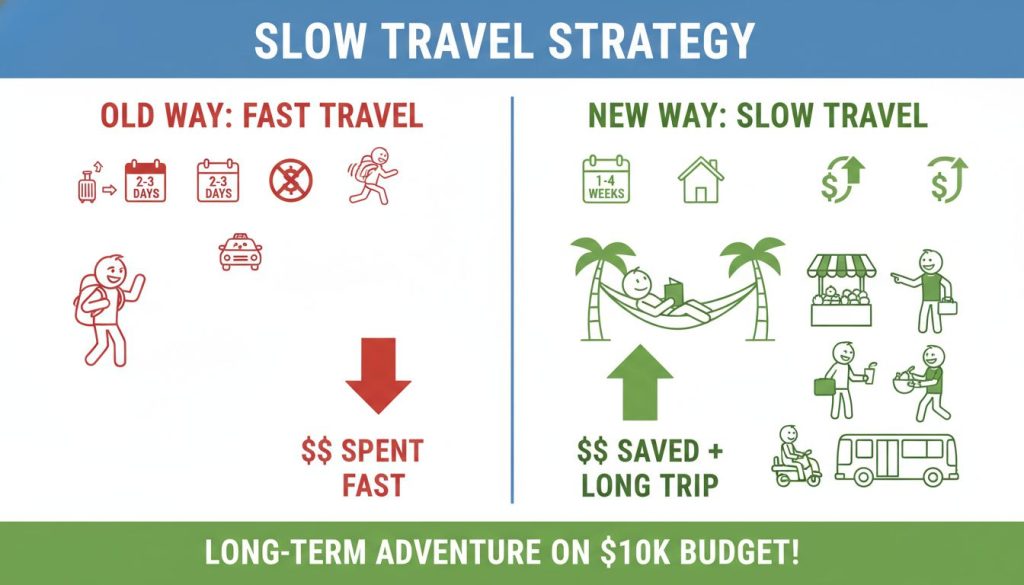
Slow travel means staying in each place for at least one or two weeks, sometimes even a month. This completely changes your financial equation.
First, you can often negotiate better accommodation rates for weekly or monthly stays, sometimes getting 20-30% off the nightly rate.
Second, you eliminate constant transportation costs between cities. Third, you start living more like a local, which naturally reduces your daily expenses.
When you stay somewhere for two weeks, you figure out which market has the cheapest fresh fruit, which street stall makes the best breakfast, and which bus route gets you where you need to go for 30 cents instead of taking a $3 taxi. You’re not constantly in “tourist mode” where everything feels unfamiliar, and you default to more expensive options because you don’t know better.
There’s also a huge psychological benefit to slow travel that I wasn’t expecting. When you’re racing from place to place, there’s constant pressure to “see everything” and maximize every single day, which often leads to spending more money on activities and transportation.
When you have two weeks in a city, you can have a lazy day reading in a park without feeling like you’re wasting precious travel time.
Those zero-dollar days are absolutely crucial for keeping your budget intact.
The Hidden Variables That Derail Most Budgets
I’ve seen so many people start their six-month trip with a perfect budget spreadsheet, and then completely blow through their money in three months. Here’s what usually goes wrong.
First, people underestimate how much they’ll want to do paid activities. You might plan to keep activities to $5 a day, but then you meet other travelers doing a three-day jungle trek, or there’s an incredible diving opportunity, or everyone’s booking tickets for an island festival.
These moments are genuinely tempting, and they’re often worth the money, but they absolutely wreck your budget if you haven’t planned for them.
The solution is to build flexibility into your budget by setting up a separate “splurge fund” of $500-1,000 for unexpected opportunities. That way, when something amazing comes up, you’re not stealing from your daily food budget to make it happen.
Second, people forget about visa costs. Depending on where you’re traveling, visa fees can add up to several hundred dollars.
Some countries offer a visa-on-arrival for $30-50, while others require advance applications costing $100-200.
If you’re planning to visit five or six countries, you could easily spend $300-500 on visas, money that needs to come from your budget.
Third, health issues and minor emergencies are essentially guaranteed over the next six months. Maybe you get food poisoning and need to see a doctor.
Maybe you drop your phone and need to replace it.
Maybe you realize your backpack is falling apart and you need a new one. These aren’t catastrophic expenses, but they’re real costs that most people don’t adequately budget for.
I recommend keeping at least $1,000-1,500 as an untouchable emergency buffer, separate from your daily spending money.
Seasonal Timing and Booking Strategy
The timing of your travel has a massive impact on costs, and you can control it with advance planning. Traveling during shoulder season or even low season can reduce accommodation costs by 40-70% in touristy areas.
For example, visiting Thai islands during the rainy season (roughly May-October) means you’ll find beachfront bungalows for $10-15 per night that would cost $40-60 during high season. Yes, you might get some rain, but it’s usually not constant downpours, more like afternoon showers.
And honestly, the reduction in crowds is worth it even without the cost savings.
Flight timing matters enormously, too. Booking international flights six months in advance versus two weeks before departure can easily save you $500-800.
That’s an extra month of travel in budget destinations.
Similarly, being flexible about your departure and return dates, even by just a few days, can make a huge difference in ticket prices.
One strategy I really like is booking one-way tickets instead of round-trip. Yes, one-way tickets are sometimes more expensive per segment, but they give you incredible flexibility to extend your trip if you’re under budget, or cut it short if you’re overspending.
Plus, some budget airlines in Asia offer ridiculously cheap one-way flights, making it cost-effective to add extra destinations.
The Accommodation Trade-offs You Need to Accept
Let’s be really honest about what budget accommodation actually means because I think this is where people’s expectations get tested the most. When you’re spending $4-10 per night on accommodation, you’re getting basic shelter, and that’s about it.
Travel Booking Strategy Calculator
Discover how much you can save by optimizing your travel timing and booking strategy. Smart planning with seasonal considerations and advance bookings can reduce your total trip costs by 40-70% in popular destinations. Use this calculator to see your potential savings.
Dorm rooms mean no privacy. You’re going to have roommates who snore, come in late, wake up early, and occasionally smell bad.
You’ll be sleeping in a bunk bed with a thin mattress and sharing a bathroom with a dozen other people.
There won’t be daily housekeeping, the WiFi will be unreliable, and the hot water situation might be questionable.
But you’re barely in your accommodation anyway. If you’re actually traveling and exploring, you’re using your hostel bed for sleeping, and that’s it.
You’re not lounging around your room during the day because you’re out seeing things, meeting people, and experiencing the place you traveled so far to visit.
The money you save on accommodation is money you can spend on experiences. Would you rather have a private room with air conditioning, or would you rather take that scuba diving course you’ve always wanted to try?
Both are valid choices, but you genuinely can’t have both on a $10,000 budget for six months.
This is the basic trade-off you need to make peace with before you leave.
Tracking Systems That Keep You Accountable
I cannot stress enough how important it is to track daily expenses when you’re operating on tight margins. I’ve watched travelers who thought they were doing fine, only to realize three months in that they’ve been averaging $15 over budget each day, which means they’ll run out of money a month early.
The system doesn’t need to be complicated. A simple notebook where you write down every expense works perfectly. Some people use apps like Trail Wallet or Splitwise, which are designed specifically for travel budgeting.
The key is recording expenses the same day they happen, not trying to remember everything at the end of the week.
What I really like is calculating a weekly budget rather than just a daily one. Yes, your target is $40 daily (or whatever your number is), but think of it as $280 weekly.
This gives you flexibility: maybe you spend $60 on a special activity one day, but then you have three $30 days to balance it out.
The weekly view helps you see patterns and make adjustments before small overspending becomes a big problem.
Every two weeks, conduct a budget review to calculate your actual average daily spending and compare it to your target. If you’re running over, you need to identify the cause and make specific changes.
Maybe you’re taking taxis too often, or eating at restaurants instead of street stalls, or buying too many drinks at night.
The data shows you exactly where your money is going.
When This Budget Genuinely Won’t Work
I want to be clear about scenarios where $10,000 for six months is genuinely not realistic, because setting yourself up for failure is worse than waiting and saving more money.
If you’re planning to travel primarily in Western Europe, North America, Australia, or Japan, you need a completely different budget. These regions need at least $70-100 daily for budget travel, which means you’d need $15,000-20,000 for six months, not $10,000.
Trying to force it just leads to misery and potentially dangerous situations where you’re skipping meals or staying in unsafe accommodation.
If you have specific activities that are non-negotiable and expensive, like multiple scuba diving certifications, skiing in the Alps, or attending major festivals, you need to budget significantly more. These experiences are absolutely worth it, but they can’t happen on an extreme budget without sacrificing everything else.
If you have medical conditions requiring specific medications, dietary restrictions requiring specialized food, or mobility issues requiring certain types of accommodation, your baseline costs are higher. There’s no shame in this; it’s just reality.
A $10,000 budget might only stretch four months instead of six, and that’s still an incredible amount of travel.
Building Skills That Reduce Costs Over Time
One thing I’ve noticed is that travelers get significantly better at budget management after the first month. There’s a learning curve to understanding what things should cost, how to negotiate, and where to find the best value.
In your first few weeks, you’ll overpay for things. You’ll take the expensive bus because you don’t know about the cheap one.
You’ll eat at the restaurant right next to your hostel instead of walking two blocks to where locals eat for half the price.
You’ll book tours through your accommodation instead of finding independent guides who charge less. This is normal and expected.
But by month two, you’ve developed instincts. You can look at a taxi driver’s opening price and know immediately that it’s three times what it should be.
You know which days markets have the freshest and cheapest produce.
You’ve figured out that the hostel breakfast is included, so you should actually eat it instead of buying food elsewhere.
These skills compound over time, which means your daily costs often decrease as the trip progresses. Many travelers find they’re spending $10-15 less daily by month four compared to month one, simply because they’ve gotten better at traveling cheaply.
This built-in efficiency can significantly extend your budget.

The Psychological Aspects of Budget Travel
Living on $40 daily for six months is as much a mental challenge as a financial one. There’s real psychological fatigue that comes from constantly making financially motivated decisions instead of just doing what you want.
You’ll have moments where you’re genuinely tired of eating street food, and you desperately want a burger and fries from a Western restaurant. You’ll walk past air-conditioned cafes on a sweltering day and really want to go inside instead of sitting at the plastic stool on the sidewalk.
You’ll see other travelers booking the private beachfront bungalow while you’re in the $6 dorm.
This is where your reasons for traveling matter so much. If you’re clear about why you’re doing this and what you’re gaining from the experience, those moments of temptation are easier to handle.
But if you’re just traveling to check off places on a list or because you think you’re supposed to, the constant budget discipline becomes exhausting.
I think it helps enormously to give yourself planned “luxury days” every couple of weeks. Budget $60-80 for one day, where you get a private room, eat whatever you want, and take taxis instead of buses.
Having these releases built into your plan prevents the feeling of constant deprivation that leads to budget-destroying splurges.
People Also Asked
How much money do I need to travel Southeast Asia for 3 months?
You can travel Southeast Asia for 3 months on about $3,000-4,500, which works out to $35-50 daily. This budget covers basic accommodation in hostels, street food and local restaurants, public transportation, and occasional activities.
Countries like Thailand, Vietnam, Cambodia, and Laos are particularly affordable, while Singapore and Brunei are more expensive.
Is travel insurance really necessary for long-term travel?
Yes, travel insurance is absolutely necessary for trips longer than a month. A single medical emergency or hospitalization abroad can cost $10,000-50,000 without insurance, wiping out your travel budget.
Good travel insurance for 6 months costs around $600-700 and covers medical emergencies, evacuations, trip cancellations, and lost belongings.
What are the cheapest countries to travel to for long periods?
The cheapest countries for long-term travel include Vietnam, Cambodia, Laos, Nepal, India, Bolivia, Guatemala, and parts of Eastern Europe, such as Bulgaria and Romania. In these destinations, you can maintain daily costs of $20-30, including accommodation, food, and transportation, if you travel like a local.
How do you budget for a 6-month trip?
To budget for a 6-month trip, first calculate your fixed costs (flights, insurance, visas), which typically range from $2,000 to $ 3,500. Then divide your remaining budget by 180 days to determine your daily spending limit.
Track every expense daily using a notebook or app, and do weekly reviews to confirm you’re staying on target.
Build in a 15-20% buffer for unexpected costs.
Can you travel more cheaply by staying in one place longer?
Yes, staying in one place for 2-4 weeks significantly reduces costs compared to moving every few days. You can negotiate monthly accommodation rates (often 20-30% cheaper), eliminate constant transportation costs, explore local pricing for food and services, and avoid tourist traps.
Many long-term travelers save $10-20 a day by adopting a slow-travel approach.
What is the average cost of hostel accommodation in Southeast Asia?
Hostel dorm beds in Southeast Asia typically cost $4-10 per night, depending on the country and location. Major cities and tourist islands are more expensive ($8-10), while smaller towns and less touristy areas can be as low as $3-5.
Private rooms in the same hostels usually cost $15-30 per night.
What we learned
Traveling for six months on $10,000 is achievable in budget-friendly regions like Southeast Asia, Central America, and Eastern Europe, but requires choosing destinations wisely and maintaining strict daily spending discipline around $35-44 after fixed costs.
Geographic selection determines whether this budget works at all, since daily costs in Western Europe or Japan are 2-3 times higher than in Southeast Asia, meaning the same $10,000 would only last 3-4 months instead of 6.
Fixed costs, including flights and insurance, consume $2,000-3,700 before you even start traveling, which means your actual daily budget is significantly lower than simple division suggests.
Slow travel dramatically extends your budget by reducing transportation costs, allowing long-term accommodation discounts, and helping you explore local pricing for food and activities that tourists typically overpay for.
Daily expense tracking using a notebook or app is essential when operating on tight margins because even small daily overages of $10-15 compound into major problems that can end your trip a month early.
Affiliate Disclosure for Smart Miles Traveler
At Smart Miles Traveler (https://smartmilestraveler.com), our goal is to provide helpful, honest, and practical travel tips, product recommendations, and money-saving strategies.
Some of the links on this website are affiliate links. This means that if you click on a link and make a purchase, we may earn a small commission at no extra cost to you.
These commissions help support the operation of this website and allow us to continue creating free, high-quality travel content for our readers.
Questions or Concerns
If you have any questions about our affiliate relationships or how this website operates, please feel free to contact us.
📧 Email: info@smartmilestraveler.com