

I used to think finding cheap flights was basically just luck. Like, you’d randomly search one day and boom, there’s a $200 ticket to Europe, and the next day it’s $800, and you’re wondering what cosmic force decided you didn’t deserve happiness.
I would spend hours switching between booking sites, clearing cookies, convinced airlines were tracking me, and raising prices out of spite.
Once, I missed a wedding in Portugal because I couldn’t justify the $1,100 fare. That really stung.
It really did.
So I got serious about understanding how this whole system actually works, and honestly, there are legitimate hacks, but they’re not what most people think they are.
How Airline Pricing Actually Works

Airlines don’t just pull numbers out of thin air. They use incredibly sophisticated revenue management systems that adjust prices in real time based on hundreds of variables.
Think of it like a stock market for seats.
Every time someone searches, books, or cancels, the algorithm recalculates what it thinks it can charge for every remaining seat on that plane. The system considers your search history, current demand, historical booking patterns, competitor pricing, seasonality, day of week, time until departure, and even local events at your destination.
The algorithm tries to fill every seat at the highest possible price. That creates predictable patterns you can absolutely exploit.
Flight hacks rely on knowing when and where to look, working within the system’s patterns rather than fighting an unpredictable force.
One effective hack to get cheap flights is to be flexible with your travel dates and destinations.
Another popular hack to get cheap flights is to sign up for fare alerts from various travel websites.
The Real Booking Window Strategy
Forget everything you’ve heard about clearing cookies or searching in incognito mode. Multiple studies, including data from Expedia’s 2026 Air Hacks Report, show this makes basically zero difference for most major carriers.
The airlines aren’t tracking your personal searches to raise prices. They’re adjusting based on aggregate demand.
The actual booking window matters tremendously, though. For domestic U.S. flights, the sweet spot is typically 28 to 90 days before departure.
For international flights, the ideal booking window is 60 to 180 days before your trip. Prices tend to be highest at the last minute and sometimes also very far in advance before airlines release their main inventory.
Ultimately, the best hack to get cheap flights involves a combination of timing, research, and being open to adjusting your plans.
These aren’t hard rules; they’re probability curves.
I tracked this myself over six months of booking trips. Flights I booked exactly 6 weeks out averaged 23% cheaper than flights I needed at the last minute.
The one time I booked four months ahead for a summer trip to Greece, I saved $340 per ticket compared to what my friends paid when they booked two months later.
You want to hit that middle zone where they’ve released most of their inventory, but before panic pricing kicks in. Waiting too long costs you, but booking extremely far in advance doesn’t necessarily help either because airlines release extra inventory and sales as the departure date approaches.
Day of Week Patterns That Actually Matter
The old “book on Tuesday afternoon” advice is partially true but mostly outdated. Airlines used to release sales on Monday night, making Tuesday morning the prime time to find deals. Now they release sales randomly throughout the week.
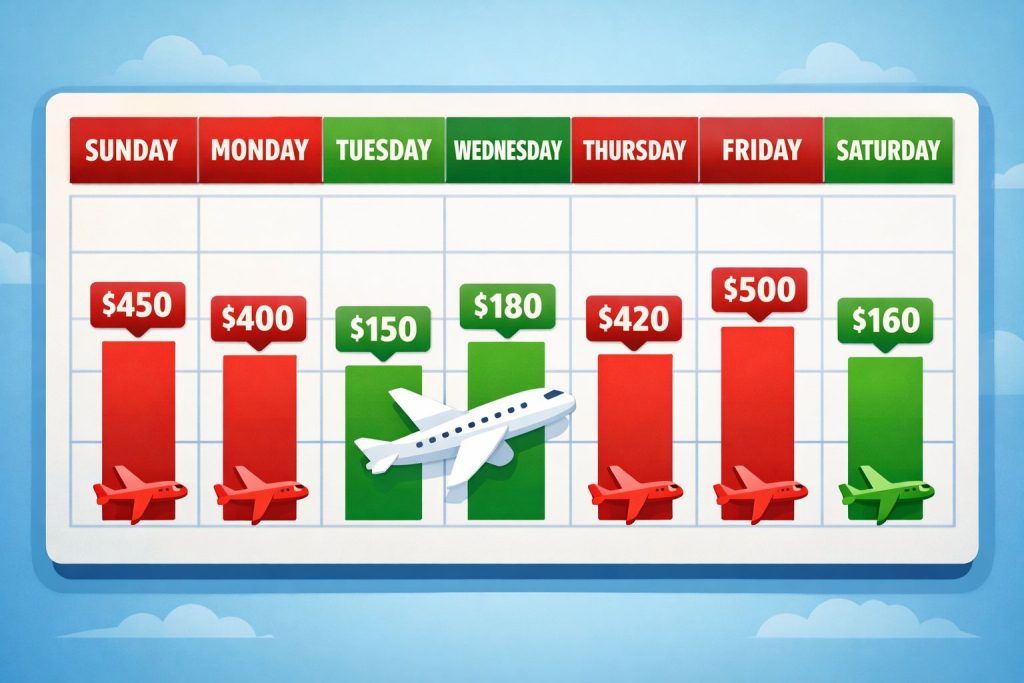
What does matter consistently is the day you fly. Tuesdays, Wednesdays, and Saturdays are genuinely cheaper for domestic travel, averaging $50 to $100 less than flights on Friday and Sunday.
For international travel, weekday departures typically save you money, with Tuesday and Wednesday leading the pack.
I tested this recently for a trip to Austin. The Friday afternoon flight was $387. The Tuesday morning flight on the same week was $214.
Same airline, same basic time of day, $173 difference.
Business travelers fly on Fridays, and airlines charge accordingly.
The return day matters too. Flying back on a Tuesday or Wednesday can shave $50 to $100 off the cost compared to Sunday returns.
If you’ve got any flexibility in your schedule, shifting your trip by even one day in either direction can yield really significant savings.
Flexibility as a Superpower
If you can be flexible about dates, destinations, or both, you unlock price differences that seem almost absurd. This is probably the single most powerful tool that exists.
Google Flights has an incredible feature that lets you search an entire month or explore destinations from your home airport, sorted by price. I used this to plan a trip when I knew I wanted to go somewhere warm in February.
By being open to either Mexico or Central America and flexible on the week, I found a $280 round-trip to Cancun when my initial dates showed $510.
The calendar view in Google Flights shows you prices for every day. You can literally see how moving your trip by two days saves you $150.
It visualizes the price fluctuations in a way that makes the decision obvious.
The same goes for alternate airports. I live equidistant from three airports.
Checking all three airports for the same trip often reveals price differences of $100 or more.
A flight from Newark might be $300, while the same route from Philadelphia is $450. The two-hour drive to the cheaper airport pays for itself immediately.
The Positioning Flight Strategy
Sometimes it’s cheaper to book a separate flight to a different city and then catch your international flight from there. These are called positioning flights, and they can unlock some genuinely wild savings.
I wanted to go to Istanbul last year. Direct flights from my city were hovering around $1,100.
But I noticed that flights from New York to Istanbul were consistently priced between $600 and $700.
So I booked a $150 positioning flight to JFK the day before, stayed with a friend overnight, and saved over $300 total even after the extra flight.
This works especially well if you have a major hub city within a few hours. Cities like New York, Los Angeles, Chicago, Miami, and Houston often offer significantly lower international fares due to competition and volume.
The positioning flight is your gateway to accessing that better pricing.
The key is building in enough connection time. I always do this across two separate bookings and give myself at least a full day between flights.
If your positioning flight gets delayed or cancelled, you don’t want to miss the expensive international leg.
Treat it like you’re starting your trip a day early, not just making a connection.
Hidden City Ticketing and Its Risks
I need to talk about this because it comes up constantly, but I’m going to be really straight with you. Hidden city ticketing, or skiplagging, is where you book a flight with a connection in your actual destination, but you only take the first leg and skip the second.
For example, a flight from Dallas to Chicago might cost $400, but a flight from Dallas to New York with a connection in Chicago costs $280. So you book the Dallas-New York flight, get off in Chicago, and never take the Chicago-New York leg.
Does this work? Yes.
Does it violate airline policies?
Also yes. Airlines really don’t like this, and there are genuine risks involved.
Your return flight will be cancelled if you skip the outbound. You can’t check bags because they’ll go to the final destination, and if the airline catches you doing it repeatedly, they can ban you from the airline or confiscate your loyalty points.
I’ve done this exactly twice, both times when the price difference was over $300, and I had no checked bags. But I’m not comfortable recommending it as a regular strategy.
The risk-reward ratio only makes sense for occasional use on routes with massive price disparities, and you need to understand you’re deliberately circumventing the airline’s fare rules.
There are websites like Skiplagged that specifically search for these opportunities, which is how they became notorious enough for airlines to sue them. Use this knowledge however you want, but know what you’re getting into.
Leveraging Alternate Routes and Stopovers
A much safer approach is to look for cheaper routes that involve creative routing. Sometimes flying to your destination via an unexpected hub costs significantly less than the direct route.
I needed to get to Budapest. The direct flight was $950.
But I found a routing through London on a different alliance that cost $680.
Yeah, it added four hours to my travel time, but $270 in savings for one extra layover was absolutely worth it for me.
Some airlines also offer free stopovers in their hub cities. Icelandair famously lets you stop in Reykjavik for up to seven days at no extra charge when flying between North America and Europe.
TAP Portugal offers similar stopover programs in Lisbon.
You’re essentially getting two trips for the price of one.
This strategy works particularly well for long-haul international flights, where you’re already committed to a long travel day. The difference between 14 hours and 18 hours of travel feels minimal when you’re crossing continents, but the difference between $800 and $1,100 is very real money.
Setting Up Effective Price Alerts

If you’ve got time before your trip, price alerts are legitimately one of the best tools available. But most people set them up wrong.
Don’t just set one alert for your exact dates and route. Set many alerts: your ideal dates, plus the week before, plus the week after.
Set alerts for alternate airports.
Set alerts for different airlines. The more data points you monitor, the better you understand the actual price range and can identify when a real deal emerges.
I use Google Flights for this primarily because it’s free, comprehensive, and actually works. When prices drop significantly, you get an email immediately.
I’ve caught price drops of $200+ within hours of them happening because I had alerts set up properly.
Hopper is another app that does this well and actually forecasts whether prices will go up or down. Their algorithm isn’t perfect, but it’s right more often than it’s wrong.
Scott’s Cheap Flights (now called Going) and Thrifty Traveler Premium are paid services that send you deal alerts, which can be worth it if you travel often and have flexibility.

The critical thing is setting alerts far enough in advance that you can actually act on them. Setting an alert two weeks before your trip is pretty useless because you’ve missed the prime booking window.
Set them two to four months out.
The Credit Card Points Strategy

This is where flight hacking gets really powerful and more complex. Travel rewards credit cards can genuinely slash your flight costs to almost nothing if you use them strategically.
The basic model is simple: you sign up for a card with a big signup bonus, often 50,000 to 80,000 points, meet the minimum spending requirement, usually $3,000 to $5,000 in three months, and then use those points to book flights. A good redemption rate gets you around 1.5 to 2 cents per point in value, meaning a 60,000-point bonus is worth $900 to $1,200 in flights.
I started doing this three years ago, and I’ve honestly flown business class to Europe twice on points that cost me nothing but regular spending I was doing anyway. The trick is treating the credit card like a debit card: only spend money you already have and pay it off immediately.
The best cards for this depend on which airlines you fly most often. Chase Sapphire Preferred and Reserve cards work well if you fly United or Southwest.
American Express Platinum gives you flexibility across many airlines.
Capital One Venture cards let you book any flight and pay with points.
Most beginners fixate on cash back instead of points. Cash back is simpler, sure, but it maxes out around 2% returns.
Strategic point use can get you 4% to 6% effective returns, sometimes more on premium-cabin flights.
The learning curve is steeper, but the payoff is substantially better.
Budget Airline Secrets and Gotchas
Ultra low-cost carriers like Spirit, Frontier, Allegiant, and Ryanair in Europe advertise insanely cheap base fares, sometimes under $50. But the base fare is almost never the actual price you pay.
These airlines make their money by unbundling everything. Carry-on bag?
That’s $40 to $60.
Checked bag? $50 to $80.
Seat selection?
$10 to $50. Printing your boarding pass at the airport?
Genuinely $50 on some carriers.
By the time you add everything back in, that $49 fare becomes $160, which might not be cheaper than a legacy carrier after all.
The hack with budget airlines is traveling truly light. If you can fit everything in a personal item, a backpack that fits under the seat, and you don’t care where you sit, and you can check in online on your phone, then these fares are genuinely cheap.
I flew Spirit to Las Vegas for $35 once by bringing literally just a backpack. It was uncomfortable and annoying, but it was actually $35 total.
Know the rules inside and out before you book. Budget airlines are ruthless about fees.
Is your bag one inch too big?
They’ll charge you $100 at the gate. You didn’t check in online?
Another fee.
They’re not being jerks; it’s literally their business model. Work within their system or avoid them entirely.
Error Fares and Mistake Pricing
Every few months, an airline or booking system makes a mistake and publishes flights at absurdly wrong prices. Like business class to Asia for $500 instead of $5,000, or transatlantic flights for $150 instead of $800.
These error fares are real, and if you catch them fast enough, they sometimes get honored. Airlines are legally required to honor tickets they’ve issued in many jurisdictions, though they can cancel bookings before issuing tickets.
The problem is they disappear within hours, sometimes minutes. You need to be following deal alert accounts on Twitter or be part of communities that share these immediately.
And you need to be ready to book instantly without overthinking it.
I’ve caught two error fares in my life. One was a $410 business class ticket to Japan that should have been $3,800.
It got honored. The other was a $180 ticket to Barcelona that got cancelled three days later with a full refund.
Even with a 50% success rate, it’s worth jumping on these when you see them. Don’t expect this to be a reliable strategy, but keep it in your back pocket as a lottery ticket option.
Follow accounts like Secret Flying, The Flight Deal, or FareDrops on social media.
When something crazy pops up, act fast and hope for the best.
Seasonal Patterns and Shoulder Season Opportunities
Every destination has a peak season, a shoulder season, and an off-season. The price differences are dramatic and predictable.
Europe in June through August is premium pricing. Europe in April, May, September, or October is 30% to 50% cheaper for essentially the same experience.
I stopped traveling during peak season entirely about four years ago. Every trip I take now is shoulder season, and I legitimately don’t feel like I’m missing anything.
Paris in May is still Paris.
Japan in November is still incredible. The Amalfi Coast in September is actually better than August because it’s less crowded.
The weather is usually still good during the shoulder season, which is why it’s called the shoulder season, not the off-season. You’re just avoiding the absolute peak crowds and peak pricing.
Hotels are cheaper too, not just flights, so your savings compound across your entire trip.
The off-season is even cheaper but comes with genuine trade-offs. The Caribbean during hurricane season is cheap for good reason.
Northern Europe in January is dark and cold.
But if you can handle those conditions, you can find absolutely incredible deals.
Building a Flight Booking Routine That Works
After years of experimenting with all this, here’s the routine that’s actually saved me thousands of dollars without becoming a part-time job.
Three to four months before I want to travel, I set up Google Flights price alerts for my target dates, the week before, and the week after. I include alternate airports.
Then I mostly forget about it and let the alerts handle it. Turn on notifications on your phone; it might be slightly annoying, but a few hundred dollars saved will make it well worth it.
When I get an alert showing a significant price drop, I check if it aligns with my dates and budget. If it does, I look at the calendar view to see if shifting by a day or two saves more money.
I check one or two other search engines quickly to confirm it’s a legitimate, good price.
If everything looks good, I book immediately. Waiting rarely helps once you’re in the booking window and you’ve found a price that works for your budget.
For trips where I have the most flexibility, no set dates, just a general timeframe, and maybe a region, I use Google Flights’ Explore feature. I literally choose my home airport and look at the entire map sorted by price.
This is how I discovered I could fly to Morocco for less than it cost to go to California.
Frequently Asked Questions
How far in advance should I book flights?
For domestic flights, book 28 to 90 days before departure. International flights work best when booked 60 to 180 days out.
These windows give you the best balance between inventory availability and pricing before panic pricing kicks in.
Are flights cheaper on Tuesday?
Flying on Tuesdays is genuinely cheaper than flying on Fridays or Sundays, typically saving you $50 to $100 on domestic flights. The same applies to Wednesdays and Saturdays.
The day you fly matters more than the day you book.
Does searching in incognito mode actually help?
No, searching in incognito mode makes basically zero difference with major carriers. Multiple studies confirm this.
Airlines adjust prices based on aggregate demand, not your personal search history.
Price fluctuations you see are normal inventory changes, not personalized tracking.
What is a positioning flight?
A positioning flight is a separate flight you book to get to a different city where your main flight departs. This can save hundreds of dollars on international flights because major hub cities often offer significantly cheaper fares due to competition.
Is hidden city ticketing illegal?
Hidden-city ticketing isn’t illegal, but it violates airline policies. Airlines can cancel your return flight, confiscate loyalty points, or ban you from future travel if they catch you doing it repeatedly.
Use it sparingly and understand the risks involved.
Do flight price alerts actually work?
Yes, price alerts work really well when set up properly. Set alerts for your target dates, plus the weeks before and after, and include alternate airports; set them 2-4 months in advance.
Google Flights and Hopper both send immediate notifications when prices drop significantly.
Are budget airlines actually cheaper?
Budget airlines are only genuinely cheap if you travel with just a personal item and avoid all add-on fees. Once you add a carry-on bag ($40-$60), a checked bag ($50-$80), and seat selection, the total cost often matches or exceeds that of legacy carriers.
What are the best credit cards for flight points?
Chase Sapphire Preferred and Reserve work well for United and Southwest flights. American Express Platinum gives flexibility across many airlines.
Capital One Venture cards let you book any flight and pay with points.
Choose based on which airlines you fly most often.
When is shoulder season for Europe?
The shoulder season for Europe is April, May, September, and October. You’ll find flights 30% to 50% cheaper than peak summer months, with better weather than off-season and fewer crowds than June through August.
Can I book the same flight for a lower price through a different airline?
Yes, alliance partner airlines often price the same flight differently. A United flight might cost less when booked through Air Canada or Lufthansa.
This is especially powerful when using points, where the same flight can have completely different point costs depending on which partner you book through.
Lets Recap
The most powerful flight hack is flexibility with your dates and destinations, often saving you $100 to $300 per ticket. Flying on Tuesday, Wednesday, or Saturday typically costs significantly less than flying on Friday or Sunday.
The optimal booking window is 28 to 90 days for domestic and 60 to 180 days for international flights. Setting up comprehensive price alerts three to four months in advance catches price drops you’d otherwise miss completely.
Positioning flights to major hubs can unlock international fares that are hundreds of dollars cheaper. Budget airlines are only actually cheap if you travel with a personal item only and avoid all add-on fees.
Credit card signup bonuses provide the most dramatic flight savings possible, effectively making flights cost 60% to 80% less when you redeem points strategically. Shoulder-season travel typically saves 30% to 50% compared to peak season, with minimal downsides.
The incognito mode hack is mostly a myth with major airlines. Checking many search engines occasionally reveals deals others miss, particularly with international budget carriers.
Save travels!
Affiliate Disclosure for Smart Miles Traveler
At Smart Miles Traveler (https://smartmilestraveler.com), our goal is to provide helpful, honest, and practical travel tips, product recommendations, and money-saving strategies.
Some of the links on this website are affiliate links. This means that if you click on a link and make a purchase, we may earn a small commission at no extra cost to you.
These commissions help support the operation of this website and allow us to continue creating free, high-quality travel content for our readers.
Questions or Concerns
If you have any questions about our affiliate relationships or how this website operates, please feel free to contact us.
📧 Email: info@smartmilestraveler.com